
Home/Resources/Infant and Early Childhood Mental Health/Understanding Perinatal Suicide Risk: What Everyone Should Know
Understanding Perinatal Suicide Risk: What Everyone Should Know

Early detection, compassionate support, and systemic improvements are essential in addressing perinatal suicide risk.
Becoming a parent can spark joy, stress, exhaustion, and everything in between. While many people have heard of postpartum depression, far fewer understand that suicide risk during pregnancy and the first year after birth is a serious and growing concern.
Research highlights that suicidal thoughts and behaviors among expectant and new parents are increasing, yet often remain unseen and unaddressed. Because a parent’s well-being is deeply connected to a child’s development, understanding and responding to perinatal suicide risk is essential for families and communities.
It is more common than most people realize
Rates of suicidal thoughts and behaviors among perinatal parents have risen sharply in recent years.
Talking openly can save lives
Creating safe, judgment-free spaces for parents to share their feelings is one of the most effective ways to support early intervention.
Pregnancy and postpartum bring unique challenges
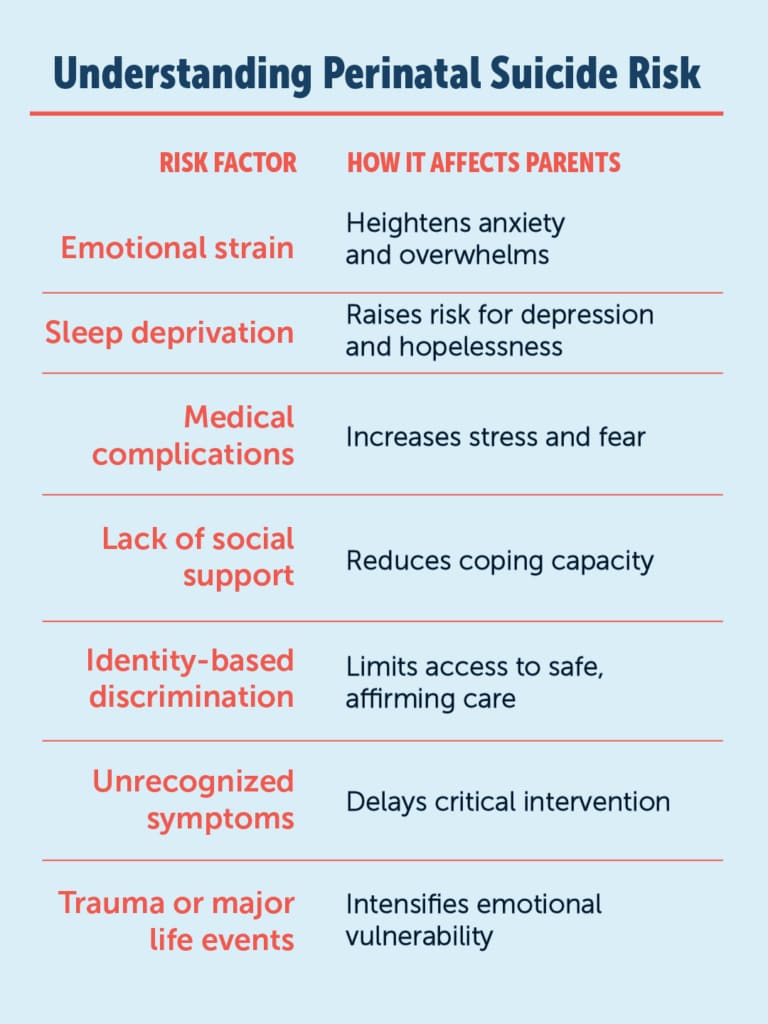
Hormonal changes, sleep deprivation, physical recovery, financial strain and identity shifts can increase vulnerability.
All types of parents can be affected
Gestational parents, fathers, nonbinary parents, adoptive parents and partners may all experience severe emotional distress. Screening and support must include every caregiver, not only mothers.
Many parents keep their struggles hidden
Stigma, shame, and fear of judgment or child welfare involvement often prevent parents from opening up about suicidal thoughts.
Screening for depression is not enough
Many health systems screen for depression, but do not directly ask about suicide risk. These are related but distinct issues.
Effective suicide screening tools already exist
Tools such as the Columbia Suicide Severity Rating Scale (C SSRS) and the ASQ are free, fast, and recommended for use with perinatal families.
Suicide has historically been undercounted in maternal health data
Past reporting systems did not consistently include suicide as a pregnancy related death, which hid the true scale of the problem.
Inequities increase risk
Parents who experience racism, discrimination, poverty or trauma face additional barriers to safe and affirming care.
A caregiver’s mental health shapes a child’s development
Parents who experience racism, discrimination, poverty or trauma face additional barriers to safe and affirming care.
What young children may experience after losing a parent
Evidence comparing impacts by age is still limited for this specific experience, but the loss of a parent for any reason generally has more adverse effects in early childhood than at older ages. Early childhood is a period of rapid brain development and deep dependence on caregivers, which makes parental loss especially destabilizing.
The effects of parental suicide are also shaped by many contextual factors. These include whether the child was present or witnessed the event, whether another emotionally available caregiver is able to support the child, the presence of trauma, the child’s developmental stage and even the timing of the loss, such as whether it occurred on a holiday or meaningful date.
The way surviving caregivers cope and the support provided to them also significantly affect a child’s long-term experience of grief.
Noelle Hause
Although every child’s experience is unique, research and clinical insights show that:
- Losing a caregiver can affect emotional regulation, behavior and long-term mental health.
- Young children may be especially vulnerable because they depend heavily on consistent, responsive caregiving.
- The impact is shaped by context, including whether there is another emotionally available caregiver, how grief is talked about and whether the child was exposed to trauma.
These insights reinforce why early detection, compassionate support, and systemic improvements are essential.
1 in 5 birthing parents struggle with a mental health disorder.
Prevention as a community-wide effort
Families and friends can play a powerful role by asking how parents are really feeling, offering practical help, listening without judgment, and encouraging care when signs of distress appear. Health and early childhood professionals can strengthen safety by screening not only for depression but also for suicidal thoughts, using inclusive and affirming language for all parents, asking screening questions throughout pregnancy and postpartum, and connecting families to appropriate mental health resources. Communities and policymakers can help reduce risk by expanding access to mental health services, supporting paid leave and family friendly policies, and investing in early childhood mental health consultation and prevention programs.
Together, these improvements create a stronger, more responsive system that helps ensure every parent receives the support they need and every child has the chance to thrive.