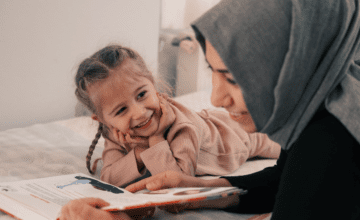


A large proportion of young children are born into and spend their early years in inherently stressful situations—families with incomes below the poverty line, food that runs out at the end of the month, unstable housing, and on top of it all, constant stress as a fact of life.
Today in the New York Times, columnist David Brooks writes about the psychological barriers to success, underscoring the effects of childhood stress and trauma on the “soft skills” that can determine success in learning and working. In the early childhood realm, we know this area as the social and emotional foundations of learning. This developmental domain used to be considered not just soft, but downright mushy. Now, thanks to greater awareness of early brain development, we know that social-emotional development is the bedrock on which later learning rests.
Brooks focuses on school-age children, but the insecurities and anxieties he talks about often have their roots in a child’s earliest relationships. Relationships with parents and other caregivers, such as early care and education providers, are the context within which early development unfolds. The security of a warm, nurturing relationship gives a baby the confidence and security to embark on the exploration of her world. That is the essence of how babies learn. When these warm responses are lacking, interacting with people and objects is more difficult and learning becomes more of a challenge.
A large proportion of young children are born into and spend their early years in inherently stressful situations—families with incomes below the poverty line, food that runs out at the end of the month, unstable housing, and on top of it all, constant stress as a fact of life. Persistent stress can be toxic to the developing brain and undermine its foundation, on which higher level cognitive functions will be built.
Nurturing relationships can buffer a young child living in the midst of stress and hardship. When caregivers are not or cannot be responsive to the young child’s need for warm interaction, the child’s emotional security falls apart. The “bricks and mortar” of brain architecture—social-emotional development intertwined with cognitive development—can begin to crumble.
Skeptical about the power of early relationships? Watch the “Still Face Experiment”, in which a mom’s deadpan face causes a baby with a healthy relationship to fall apart within seconds. Imagine a baby whose parent or caregiver isn’t responsive, because of depression or lack of understanding about how to parent. That baby quickly learns that the world isn’t her oyster, and her emotional responses start to shut down.
Social-emotional development is an important component of a child’s readiness to be successful in school, to self-regulate, sit in a circle and later at a desk, focus on what is going on around him and the task at hand. Insecurity in relating to others means not trusting adults and therefore not being motivated to learn.
Brooks’ column chronicles how anxiety and insecurity play out in school. The Adverse Childhood Experiences Study (ACES), which the column cites, shows how a child’s early negative experiences reverberate throughout adulthood. (Watch videos of Vince Felitti, the study’s director, at ZERO TO THREE’s 2011 National Training Institute.)
Now for the economy part. The link should be clear: children in stressful environments whose close relationships don’t buffer hardships; to children without the social-emotional foundations of learning; to children falling behind in school; to adults with lower earnings power and greater health problems; to a workforce that can’t compete in the global economy. But positive links can be forged. Nobel laureate and economist, James Heckman puts the equation this way: investing in the early years to provide disadvantaged families equal access to successful early development yields cognitive AND social skills in the early years and, if that development is sustained with effective education through adulthood, equals more capable, productive and valuable citizens. And it pays dividends for generations.
So what can we do to help parents, caregivers, and babies hug more (and smile, talk and respond, play games, sing songs, read books, tell stories, go exploring, watch a dandelion scatter on the wind)? As Brooks notes, people in different policy areas, such as health, education, poverty, and crime, are grappling with the same problem of enormous stress and its effects on behavior. The solutions call for integration of many approaches, a “baby blanket of care” to reach out and support the development of all young children. Policymakers looking to build a strong economy for the future might consider:
- Paid Family Leave— Taking time off from work to bond with baby is a luxury many young families can’t afford. The U.S. needs to drop the dubious distinction of being the only major developed nation without a paid family leave policy.
- More home visiting services— Parents have a tough job, and it helps to have someone show them the ropes, how to support their child’s development, and connect with community services. The Affordable Care Act (ACA) planted the seed of proven home visiting approaches, a beginning that should be sustained and expanded.
- High quality early care and learning programs— Teachers and caregivers skilled at forming relationships and facilitating baby learning are the backbone of high quality programs. But such quality comes at a price, making it all too scarce and out of reach for many families. Expanding Early Head Start (EHS) so more disadvantaged infants and toddlers could benefit from its proven services and increasing the Child Care and Development Block Grant’s capacity to serve more infants and toddlers with higher quality services would be serious education reform.
- Choosing the expanded Medicaid option— Parents need to take care of themselves as they take care of their children, with regular health care, mental health services, and building strong support networks with family and friends. Choosing the state option in ACA for expanding Medicaid coverage to more adults would be a good place to start.
- An Infant and Early Childhood Mental Health (IECMH) Strategy—Young children can and do experience mental health issues that need to be addressed in the context of their close relationships. A few parts of that strategy: more mental health professionals trained in IECMH, infusing knowledge of social-emotional development into early childhood programs, and reimbursement through Medicaid and private health plans of approaches that treat parents and children together.
- Child welfare policies and practices that support the development of maltreated infants and toddlers— These vulnerable young children are at the greatest risk for developmental harm. Child welfare policies need to be reoriented to ensure they have caring relationships they can count on.
Some might call this a “baby hugger’s agenda”. So be it. Perhaps someday, passing a playground full of happy, healthy toddlers might give us satisfaction similar to driving through the John Muir Wood—with the added benefit that our economic future will be on a firm foundation.