
3-Month-Old Milestones: What to Expect From Your Baby

Key Takeaways
- Movement and head control: Your baby may hold their head steadier, lift their head and chest during tummy time and move their arms and legs with more control.
- Vision and hearing: Your baby may watch your face, follow nearby moving objects and respond more noticeably to familiar voices and sounds.
- Early communication: Coos, gurgles, cries and facial expressions are all ways your baby communicates with you before words begin.
- Social connection: Social smiles and back-and-forth interaction may become more frequent as your baby becomes increasingly interested in familiar people.
- Every baby develops differently: These 3-month-old milestones describe skills that may be emerging around this age—not a checklist your baby has to complete on a deadline.
At 3 months, your baby may be becoming more alert, social and physically coordinated. These common three month old milestones may include stronger head control, more purposeful arm and hand movements, social smiles, coos, attention to familiar faces and voices, and growing interest in the world around them.
These developmental milestones are guideposts, not deadlines. Every child’s development unfolds at their own pace, and the CDC does not publish a separate checklist for 3 month olds—this age falls between its 2- and 4-month milestone checklists. CDC checklists describe skills that most babies—75% or more—can do by a specific age.
Three months is often a turning point in parenthood! Compared with the newborn weeks, you may notice that your little one stays alert longer and is increasingly interested in you and the world nearby. From birth through these early months of age, babies and other infants develop quickly, but no two children follow exactly the same timetable.
Right around 3 months is also the time when your child becomes more aware of the world around her and the people in it (like you!). This awareness leads to the beginning of back-and-forth play. A smile may lead to another smile. Your baby’s coo may invite you to answer. When you respond, you are supporting your baby’s development through the everyday relationships and interactions that are central to healthy child development.
As you read about what to expect from a 3-month-old, remember: milestones are not a race. What matters most is noticing how your baby is growing, responding to their cues and enjoying the new ways the two of you can connect.
3-Month-Old Milestones at a Glance
As you review the chart, keep in mind that development is not a race and that every child grows at their own pace and in their own way. At 3 months, many skills are still emerging. You may notice changes in your baby‘s physical development, language development, social connection and early cognitive milestones—but your baby does not need to show every skill at exactly the same time.
| Developmental Area | What You May Notice | How You Can Support Your Baby |
|---|---|---|
| Physical & Movement | Your baby's head control may be getting steadier. I push myself up to see the people I love and the things that interest me. During tummy time, your baby may lift their head and chest higher, move their arms and legs more smoothly and open their hands more often. | Make sure your baby gets time to play on both their back and stomach. Offer short periods of supervised tummy time and plenty of safe floor play so your baby can practice moving their body. |
| Vision & Hearing | Your baby may spend more time watching faces, making eye contact and following moving objects with their eyes. You may also notice early hearing milestones, such as becoming more attentive to sounds or turning toward familiar voices. | Talk with your baby face-to-face, slowly move a toy or other interesting object for them to watch, and sing or use gentle sounds to capture their attention. Follow your baby's cues and give them a break when they look away. |
| Communication & Language | I communicate by using sounds, actions, and facial expressions. I can make a few different sounds in response to your sounds—babbles, coos and gurgles. These back-and-forth sounds are an important part of early communication and language development. | Have back-and-forth “conversations” with your baby. When you reply to their coos and gurgles, they learn that you care about what they are saying. Try copying a sound your baby makes, then pause to give them a chance to respond. |
| Social-Emotional & Developmental | Your baby may smile more in response to you, hold eye contact for longer and become especially interested in familiar faces and familiar voices. They may also calm when you pick them up, speak to them or respond to their cries. | Watch and respond to your baby's signals. Smile back, talk to them and comfort them when they need you. These everyday back-and-forth moments help your baby learn that they can communicate with you and count on you. |
| Cognitive & Sensory | I use my hands and fingers to explore. I reach for and grasp objects and toys. I explore them with my fingers, hands, and mouth to figure out what they can do. You may also notice your baby watching their own hands, bringing their hands to their mouth or becoming more interested in how their movements affect nearby toys and people. | Offer your baby toys to explore that have different shapes, sizes, textures, and sounds. Choose simple, safe objects that are easy to look at, touch or grasp, and follow your baby's interests rather than trying to direct every moment of play. |
What this means for you: These behaviors are examples of what you may notice around 3 months—not a checklist your baby has to complete. Your warm responses, conversation and opportunities to safely move and explore give your baby what they need most: a relationship that supports learning and development.
Physical and Movement Milestones at 3 Months
Your baby’s movements may look smoother and more intentional than they did during the newborn stage. You may notice your baby has more control of their head, arms, legs and body as strength and coordination continue to develop.
Around 3 months, your baby may:
- Hold their head steadier when you carry or support them
- Lift their head and chest during tummy time
- Move their arms and legs more smoothly and with greater purpose
- Bring their hands toward the middle of their body or to their mouth
- Keep their hands open more often
- Swipe or bat toward nearby toys
- Begin reaching for or briefly grasping objects
These changes are part of your baby’s physical development, but they don’t all happen at once. One 3-month-old may be fascinated by reaching for a toy while another is putting most of their energy into building stronger head control. Both are learning through everyday movement and play.
Tummy Time and Head Control
Tummy time gives your baby opportunities to strengthen the neck, shoulders and upper body muscles they use for head control and later movement. By around 3 months, the supplied guidance recommends working toward about 15 to 30 minutes of tummy time over the course of the day. That doesn’t have to happen all at once—several short sessions can add up.
Tummy time should always happen while your baby is awake and supervised. If your baby isn’t a fan at first, start with just a few minutes when they are rested and alert. You can get down on the floor face-to-face, talk or sing, or place an interesting toy nearby.
Your baby might be saying, “It’s hard work holding up my head! Stay close so I can look at you while I practice.”
Should a 3-Month-Old Be Rolling?
Some babies may begin rolling or shifting their weight as if they are getting ready to roll around this age. Others won’t roll yet. Rolling is not something every baby needs to do by 3 months.
What you may notice instead is your baby turning their body, moving from side to side or using their arms and legs with increasing control. These are all ways babies practice the strength and coordination they will use as new movement skills develop.
Because rolling can sometimes happen unexpectedly, keep a hand on your baby whenever they are on a changing table, bed, couch or other raised surface.

Hands and Fine-Motor Development
Your baby is also learning that their own hands are useful tools for exploring. You may see them look at their hands, bring them to their mouth, swipe at nearby objects or begin to reach for and grasp toys.
Offer safe objects that are easy to see and touch, such as rattles or other lightweight soft toys. Your baby doesn’t need a complicated activity. Reaching, touching, mouthing and dropping objects all give them chances to develop control and learn how their movements affect the world around them.
Vision and Hearing at 3 Months
At 3 months, your baby may seem increasingly interested in the people and activity around them. Their vision and hearing are still developing, but you may notice longer periods of looking, listening and responding to what is happening in their world.
You may see your baby:
- Look closely at familiar faces and spend more time making eye contact
- Follow moving objects or your face with their eyes
- Watch a slowly moving toy as it travels from side to side
- Pay attention to simple or high-contrast pictures and patterns
- Become more alert when they hear familiar voices
- Respond to sounds by becoming still, moving their body, changing their facial expression or turning their head
- React to a variety of everyday sounds, from conversation and soft music to sudden loud noises
Around 2 to 3 months, babies may be able to focus on faces and objects about 8 to 12 inches away and increasingly track movement across their field of vision. That helps explain why your face is such an interesting “toy” during feeding, cuddling and face-to-face play.
You might try holding your face or a simple toy where your baby can comfortably see it, then moving slowly from side to side. Talk as you move: “Here I am. Can you find me?” Give your baby time to look and respond.
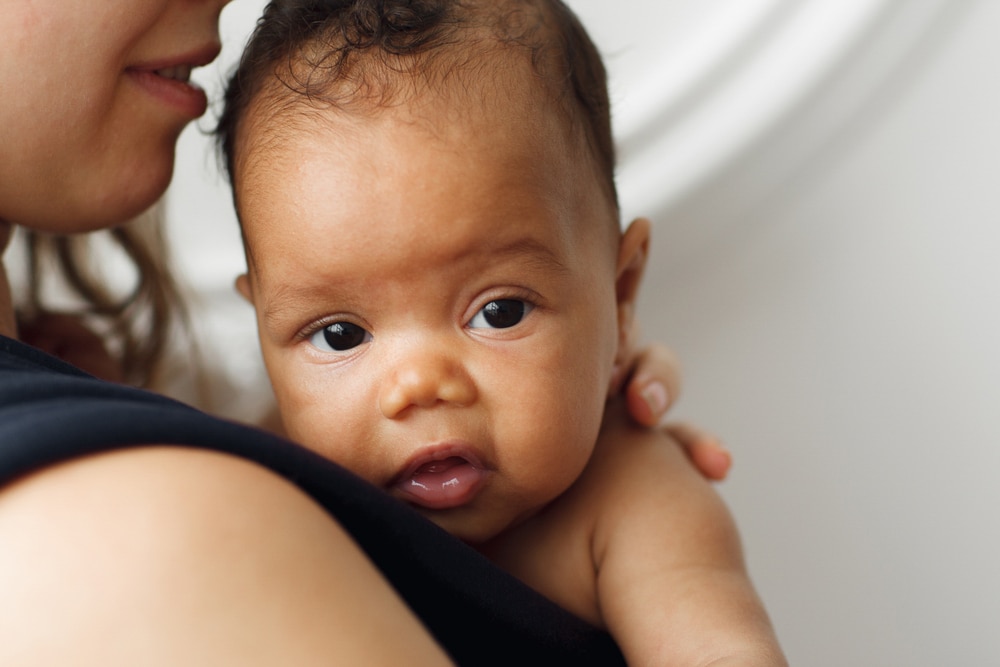
Hearing also supports communication and early brain development. Your baby may recognize familiar voices and become more attentive when you talk, sing or make other sounds. These back-and-forth moments help connect what your baby sees and hears with the people who care for them.
Vision and hearing continue to mature well beyond 3 months, so don’t expect your baby to see or respond like an older infant. If you are concerned about how your baby sees, hears or responds to people and sounds, share what you are noticing with your child’s health care provider.
Communication and Language Milestones at 3 Months
Long before your baby says their first word, they are learning that sounds, actions and facial expressions can be powerful forms of communication. When your baby cries, smiles, moves their body or makes a sound—and you respond—they begin to learn that their efforts to communicate matter.
Around 3 months, you may hear more of your baby’s coos, gurgles and other sounds beyond crying. These aren’t words yet, but they are an important part of early language development. The supplied research notes that social cooing and early back-and-forth vocalizing commonly emerge during this period.
Your baby might be saying, “When I make a sound and you answer me, I learn that we can have a conversation—even before I have words.”
You may notice your baby:
- Coos, gurgles or makes different vowel-like sounds
- Uses cries, movements and facial expressions to communicate different needs or interests
- Responds to your voice with movement, expressions or sounds of their own
- Becomes more attentive when they hear familiar voices
- Pauses, watches or seems to wait for you during a back-and-forth communication
You don’t need special lessons to encourage early communication. Talk with your baby throughout the day about what you are doing: “I’m putting on your socks. One foot, then the other!” When your baby coos, try making a similar sound back. Then pause. They may answer with another coo, a wiggle, a smile—or simply watch you.

Babies respond in different ways. One baby may be very vocal while another communicates more often through looks, movements or facial expressions. Follow your baby’s cues rather than looking for one exact vocal pattern.
Have back-and-forth “conversations” with your baby. When parents respond to a baby’s babbles, coos and gurgles, babies learn that someone cares about what they are “saying.”
You can also introduce your baby to books. At this age, reading is less about following a story and more about hearing your voice, looking at pictures and enjoying time together.
Social-Emotional Development and Bonding at 3 Months
Around 3 months, your baby may become noticeably more interested in the people who care for them. You may see longer periods of eye contact, more smiles and growing attention to familiar faces and familiar voices.
One especially exciting change is the social smile—a smile that happens in response to another person. The supplied research notes that intentional social smiling commonly emerges and becomes more established during approximately the first 6 to 12 weeks of life, alongside early cooing and reciprocal interaction.
You may notice your baby:
- Smiles when you smile, talk or interact with them
- Watches your face and makes more eye contact
- Seems especially interested in familiar faces
- Becomes calmer when they hear familiar voices or are picked up and confronted
- Shows excitement through smiles, wiggles, kicks or sounds when a familiar caregiver approaches
- Begins to take part in simple back-and-forth interactions with parents, caregivers or older siblings
Your baby is also learning an important lesson from the way you care for them: “When I need you, you respond.”
A hungry baby cries, hears a caregiver’s reassuring voice and then calms when they are picked up. Over time, experiences like these help your baby learn that their needs matter and that someone they trust will help them manage uncomfortable feelings.
That doesn’t mean you have to respond perfectly or prevent your baby from ever becoming upset. Responsive parenting means noticing your baby’s cues and responding warmly and consistently as you are able. These everyday interactions help build emotional security—a growing sense that the people who care for your baby are there when they are needed.

This security supports more than bonding. When a child feels safe and connected, they have a strong foundation for exploring, communicating and learning about the people and world around them. These relationships continue to matter throughout infancy and as your baby grows into a young child.
Learn more about responsive parenting and how everyday interactions help build strong emotional bonds from birth.
What this means for you: Your baby loves your face, your voice and the back-and-forth moments you share. The most important support you can offer isn’t a special activity—it’s being there to notice, comfort, smile, talk and respond.
Cognitive and Sensory Milestones at 3 Months
Your baby’s brain is busy learning from everything they see, hear, touch and do. At 3 months, many early cognitive milestones happen through simple everyday experiences—watching your face, listening to your voice, exploring their own hands and discovering what happens when they move their body.
When your baby experiences hunger, she communicates by crying and begins to connect you with the comfort and food that follow. Your baby is starting to recognize patterns—when this happens, something else often happens next.
Around this age, you may notice your baby:
- Looks closely at their own hands or brings them toward their mouth
- Watches your face or an interesting object for longer periods
- Begins to track moving objects with their eyes
- Becomes increasingly interested in nearby toys, faces and sounds
- Explores safe objects by looking, touching, grasping or mouthing them
- Repeats movements that produce an interesting result—such as batting at a toy and watching it move
- Begins to recognize familiar patterns in everyday routines and interactions
These behaviors may seem simple, but they are important parts of early development. Your baby is gathering information about their world and beginning to make connections between what they do and what happens around them.
You can encourage this learning through ordinary play. Offer a simple toy your baby can see, touch or grasp. Slowly move it so they can track it with their eyes. Let them explore their hands and mouth. If they become absorbed in looking at your face instead of the toys you picked out, that’s learning too.
Your baby might be saying, “When I touch this, it moves. When I make a sound, you answer. When I look at you, you smile. I’m figuring out how my world works.”
There is no need to keep your baby constantly stimulated. Babies learn best when they have opportunities to explore while a trusted caregiver follows their interests and notices when they need a break. Those simple back-and-forth experiences help your baby learn while strengthening the relationship that supports all areas of development.
Simple Activities for a 3-Month Old
You don’t need elaborate activities or special equipment to support your 3-month-old’s development. Some of the best simple activities involve giving your baby time to move, look, listen and interact with you. At this age, play is about connection and exploration—not practicing skills until your baby masters them.
Follow your baby’s cues as you play. When they are alert and interested, keep going. When they look away, fuss or seem tired, it’s okay to stop and try again later.
Tummy Time
Place your baby on their tummy while they are awake and supervised. Get down where they can see your face and talk or sing to them. You can place a simple toy nearby to encourage them to lift their head or look from side to side.
Tummy time helps strengthen the neck, shoulders and trunk muscles your baby uses for head control and future movement. Short sessions throughout the day are fine—you don’t have to do all of your baby’s tummy time at once.
Try saying: “There you are! You’re working hard to lift your head. I see you!”
Face-to-Face Talk
Your face and voice are some of your baby’s favorite things to explore. Hold your baby where they can comfortably see you, then talk, smile and make simple sounds. If your baby coos or gurgles, copy the sound and pause to see what happens next.
Your baby may coo back, smile, wiggle or simply watch you. All of these can be ways of joining the conversation. These playful exchanges help your baby learn about communication while strengthening your connection.
Parents, caregivers and older siblings can all join in. Keep voices gentle and give your baby time to respond.
Follow the Toy
Hold a simple, lightweight toy where your baby can see it. Slowly move it from one side to the other and give your baby time to follow it with their eyes.
Rattles, high-contrast objects and other safe toys or soft toys can work well. Your baby doesn’t have to follow the toy every time. If they’re more interested in your face, that’s a perfectly good focus for play too.
Read Together
Even though I’m so young and don’t use words yet, I love to look at books.
Choose books with simple, large pictures or high-contrast designs. Hold the book where your baby can see it and talk about the pictures: “Look at the big red ball!” Your baby may watch, listen, touch the page or lose interest after only a few minutes.
That’s okay. At 3 months, sharing a book is less about finishing the story and more about enjoying your voice, your face and time together.
Listen and Sing
Sing a favorite song, hum a lullaby or play gentle soft music. Your baby may become still, move their arms and legs, smile or make sounds in response.
Songs with repetition can be especially fun because your baby begins hearing familiar patterns. Your voice is enough—you don’t need to be a great singer.
Bicycle Legs
Lay your baby on her back and gently move her legs back and forth as if she is pedaling a bicycle. You can also change the pace of the movements, going slower or faster.
As you pedal, sing to her or talk with her about your game: “Now let’s go up the hill…now dowwwwn the hill. Should we go fast or slow?”
Keep the movement slow and comfortable, and stop if your baby seems unhappy or wants a break. The goal isn’t exercise—it’s playful movement, language and connection.
Airplane
Hold your baby securely in front of you. Gently move him so that he is “flying” through the air like an airplane. Carry him to interesting objects—near colorful toys, over a patterned rug or near a mobile—and move him to different heights.
Watch your baby’s face and body as you play. If they smile and stay engaged, you can continue. If they look away, stiffen, fuss or seem overwhelmed, bring them close and take a break.
Mirror Play
Hold your baby safely in front of an unbreakable mirror or sit with them where they can see their reflection. Smile, point and describe what you see: “There’s your nose. And look—there’s my face too!”
Your baby doesn’t yet understand that the reflection is “me,” but looking at faces, expressions and movement can be fascinating at this age. Keep mirror play short and follow your baby’s cues.
Want more ideas? Explore the stages of play from birth to 6 months or find more age-appropriate activities in ZERO TO THREE’s 0–6 month Milestones & More Kit and other Milestone Kits. Remember, what your baby loves most about these activities isn’t the toy or game—it’s sharing the experience with you.
How Can I Support My 3-Month-Old's Development?
You can support your 3-month-old’s development through ordinary, responsive interactions—not by pushing your baby to “practice” milestones. When you notice your baby’s cues, respond to their sounds and expressions, and give them safe opportunities to move and explore, you are helping your baby learn.
Your baby’s cues can tell you a lot about what they need. Crying, sucking on their fingers or making certain movements may be signs that your baby is hungry. Looking away, closing their eyes, yawning or becoming fussy may tell you they are tired or need a break from play.
You don’t need to interpret every cue perfectly. Over time, you and your baby learn more about each other.
Here are some everyday ways to support development:
- Follow your baby’s lead. Interact when your baby is alert and interested. If they turn away, close their eyes or begin to fuss, pause and give them time to rest.
- Respond to their communication. Your baby uses cries, facial expressions, body movements and sounds to communicate. When you respond, your baby begins learning that their actions have meaning.
- Talk through everyday routines. Diaper changes, getting dressed, bathing and feeding are all chances to talk with your baby: “Here’s your clean shirt. One arm goes in, and now the other.”
- Make time for face-to-face connection. Your baby may be especially interested in familiar faces. Smile, imitate their expressions and give them time to respond.
- Read and sing together. Your voice helps make everyday moments interesting and supports early communication and learning.
- Give your baby room to move. Supervised tummy time and safe floor play allow your baby to stretch, kick, reach and explore their body.
- Keep toys simple. A few safe objects to look at, touch, grasp or listen to are plenty. You don’t need to constantly entertain your baby.
- Let your baby stop when they’re done. The original article notes that around 12–14 weeks, a baby may look carefully at a toy or book for only a few minutes before looking away, dropping it, closing their eyes or crying. These can be signs that it’s time for a break—not that you’re doing anything wrong.
Eating and sleep may also begin to feel a little more predictable around this age, but every baby’s rhythms are different. Rather than trying to make your baby’s schedule match another child’s, pay attention to their individual cues around sleeping, waking, play and feeding.
Your baby might be saying, “Sometimes I want to play, and sometimes I need a break. When you watch me and respond, you help me feel understood.”
These back-and-forth experiences support more than one developmental skill at a time. Your baby is practicing movement, learning communication, recognizing people and patterns, and building trust in the people who care for them.
If you have questions about your baby’s development or health, you don’t have to figure everything out on your own. Share what you’re noticing with your child’s health care provider. And remember: the most important thing parents and caregivers offer at this age isn’t a perfect activity or schedule. It’s a responsive, loving relationship your baby can count on.
What If My 3-Month-Old Is Not Meeting Every Milestone?
Babies develop at different rates, and one isolated skill does not determine whether a child has a developmental delay. Milestones are guideposts that help you notice how your baby is changing over time—not a test your baby has to pass on a particular day.
The CDC does not publish a separate developmental milestone checklist for 3 months. Instead, three months of age falls between the CDC checklists for two months and four months. The CDC’s milestone framework describes skills that most babies—at least 75% of children—can do by a specified age.
That means a 3-month-old may be working on skills from the earlier checkpoint while beginning to show some skills that become more common closer to 4 months. Most children do not develop every skill at exactly the same time or in exactly the same order.
Milestone checklists are also different from developmental screening. A checklist can help you observe your baby’s growth and development and organize questions for a healthcare provider, but it cannot diagnose a developmental condition. Developmental screening uses standardized tools and is typically completed with a qualified professional.
If your baby was born prematurely, ask your health care provider whether you should use corrected—or adjusted—age when thinking about development. Corrected age takes into account how early a baby was born and may provide a more useful developmental comparison during infancy.
It is also helpful to remember that developmental growth is different from physical growth. Weight, length and head circumference are tracked separately from developmental skills.
When Should I Talk With My Baby's Health Care Provider?
You know your baby well. If something about their development or health concerns you, you do not need to wait for the next milestone checklist to bring it up.
Talk with your baby’s healthcare provider if you notice things such as:
- Little or no response to voices or other sounds
- Difficulty following faces or objects with their eyes
- Persistent difficulty lifting or controlling the head
- Very little interest in faces or social interaction
- Few emerging attempts to communicate through sounds, expressions or movement
- A noticeable difference in how the two sides of the body move
- Loss of a skill your baby was previously able to do
These are not a diagnosis or a checklist of warning signs for one specific condition. They are simply signs and concerns worth sharing with a professional who can look at your baby’s development as a whole.
Your child’s pediatrician or another qualified professional can help you decide whether additional observation, developmental screening or early intervention may be useful. The American Academy of Pediatrics also emphasizes ongoing developmental surveillance as part of pediatric care.
If you are getting ready for an appointment, learn more about how to partner with your child’s health care provider.
What this means for you: You don’t need to compare your baby with every other 3-month-old. Watch how your baby changes over time, enjoy the skills that are emerging and bring your questions to a professional whenever you have them.
What Comes Next?
As your baby approaches four months, you may notice their movements, communication and social interactions becoming even more purposeful. The skills you see now continue to develop gradually rather than appearing all at once.
In the coming weeks, your baby may begin to show:
- Stronger head and body control
- More interest in reaching for and exploring objects
- More deliberate hand movements and grasping
- A wider variety of coos and other sounds
- Longer periods of social play, smiling and back-and-forth interaction
- Growing curiosity about the people and objects around them
You don’t need to rush your baby toward the next set of milestones. Keep offering the same things that support healthy development now—time to move, chances to look and explore, conversation, comfort and responsive play.
If you’d like to look back at what came before, explore 2-month-old milestones. When you’re ready to see what may emerge next, continue to 4-month-old milestones.
From two months to three months to four months and beyond, your baby’s development is a process—not a race. The loving, responsive relationship you build along the way is what gives your baby a secure place to keep learning, exploring and growing.
What’s on Your Mind? Frequently Asked Questions About 3-Month-Old Milestones + Questions From Real Parents
They’re close, but not always exactly the same. Twelve weeks is 84 days, while calendar months vary in length. A baby who is 12 or 13 weeks old is generally in the same developmental period as a 3-month-old, but development does not change on a particular day.
Instead of treating “12-week milestones,” “13-week milestones” or 3-month milestones as separate deadlines, look at how your baby is developing over time.
Your baby may already show that certain people are familiar. They may pay special attention to your face, become alert when they hear your voice, calm when you pick them up or respond differently to the people they spend the most time with.
Babies learn familiarity through repeated experiences with faces, voices, smell, touch and caregiving routines. This is different from the more complex kind of recognition an older child or adult has, but it is an important part of early social development.
Your baby might be saying, “I know your voice, your touch and the way you comfort me. You feel familiar.”
Not necessarily. Grabbing the feet is not a skill every baby needs to show at 3 months. At this age, your baby may be more focused on discovering their hands, bringing their hands toward the middle of their body or mouth, and reaching or swiping toward nearby objects.
Body exploration develops gradually. Your baby may discover their feet later as their coordination and flexibility continue to grow.
Answer TBD
Moms and dads are special to their children in ways that no one can replace. The bond between you and your child is stronger than all others. You will always be #1 for hugs and kisses, nose wipes, band-aid application, and night-time tuck-ins.
Even so, know that you are not alone in these worries. Many parents who “share the care” with child care providers also occasionally experience uncomfortable, hard-to-deal-with feelings such as jealousy, competition, and guilt. It’s important to be aware of these emotions, because when we act on them without thinking, it can have unintended negative consequences. For example, one mom who was worried about her son’s close attachment to his child care provider found herself limiting the time she spent with her son’s provider at drop-off and pick-up. When she did, the interaction was strained. You can see how this could be very confusing and upsetting to her son, and how it could create a very tense relationship between Mom and caregiver—which is never good for a child.
There may also be times when you find your child’s reactions to hellos and good-byes confusing. Your child might seem as though he doesn’t want to leave at the end of the day, as he clings to his caregiver and cries when you take him into your arms. While this may feel awful, it doesn’t mean your child loves his caregiver more than you. More likely, your child is “telling” you, I’m having such a good time here. I need a little time to adjust to the idea that it’s time to go. Or he might be saying, I missed you so much when you left. Then Ms. Peggy helped me have a good day. Suddenly, here you are. I need a little time to let go of Ms. Peggy and get reconnected with you again. Though these moments are hard, your child is letting you know that she can trust you with her strongest feelings.
Child care providers can be wonderful partners. They know a lot about your child. This information can be a rare gift. A strong relationship with your provider can actually enhance your relationship with your child, and help you see—in a new light—what a wonderfully interesting and lovable person you are raising.
This is not unusual at all. During the first 3 months, babies are using most of their energy to adapt to the outside world. There may be periods when she enjoys looking at her toys (show her bright ones she can easily see) or listening to your voice as you read stories. But some babies are still more interested in sleeping and eating than playing.
What’s most important in these early months is to follow your baby’s cues. Comfort her when she is distressed; interact with her when she is alert and ready for play. By the fourth month you will see her become more interested in exploring and learning about the world around her.
Right around 12-14 weeks, you might see your baby grasping small toys like rattles with her hands, looking carefully at colorful objects and illustrations in books, and mouthing and chewing on her teethers or other toys. This may only last a few minutes. Then you’ll notice that she might look away, drop the toys, close her eyes, or even start to cry. This is her way of saying, Okay, I need some rest time now. Put the toys away and give her the break she needs, either by cuddling or swaddling her, or by putting her down in the crib for a few minutes. She will show you when she’s ready to play again by looking eager and alert. If you don’t see your daughter becoming more alert and interested in interacting with you over the next month, talk with your pediatrician or other trusted professional about your concerns.
