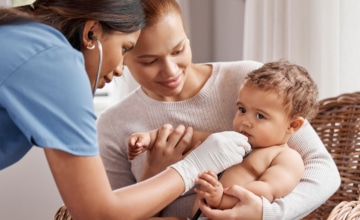

Weaving the Promotion of Early Relational Health and Child Development Into Clinical Practice: Keystones of Development Grand Rounds With Mount Sinai
During this webinar, leaders from the Mount Sinai Parenting Center share strategies for health centers to promote positive child development through well-child visits for patients ages 0-5.

The Early Childhood Developmental Health Systems (ECDHS): Evidence to Impact Center hosted a webinar highlighting Mount Sinai’s Keystones of Development to help health centers facilitate early childhood development (ECD) practice improvements, promote positive child development, and strengthen caregiver-child relationships in pediatric primary care well-child visits. The webinar was held with representatives from 151 health centers funded by the Health Resources and Services Administration (HRSA) to improve developmental outcomes among children ages 0-5 through increased screenings and follow-up services.
In this webinar, Blair Hammond, MD, and Aliza Pressman, PhD, LCSW, from the Mount Sinai Parenting Center share implementation strategies, stories from the field, community health center approaches, an overview of resources, and tests of change opportunities to help attendees and viewers:
- Recognize how safe, stable, nurturing relationships serve as a foundation for optimal child development and health and can buffer the adverse effects of toxic stress.
- Identify opportunities within the primary care visit to model and foster caregiver behaviors that support a child’s attachment, autonomy, and self-regulation.
- Outline a specific plan to incorporate at least one new free resource or strategy that “sparks” the promotion of early relational health and child development in clinical practice.
Free provider resources are also available from the Mount Sinai Parenting Center.
Key Takeaways
- The Keystones of Development focuses on six keystones: secure attachment, autonomy, self-regulation, perspective taking, problem solving, and academic knowledge. The keystones are well supported by research, largely dependent on parent/caregiver behaviors, able to be promoted through teachable moments, and strongly predictive of later well-being.
- Providers can discuss, model, and praise specific positive caregiving interactions during clinical encounters to help promote early relational health and childhood development.
- Secure attachment is a positive view of self and others and relationships based on the early experience of feeling loved, safe, and protected by the primary caregiver.
- This dynamic process develops over time and can improve throughout life.
- Secure attachment might appear differently depending on context and community, but the underlying basis is attuned connection.
- It buffers the impact of adversity – closely connected relationships can move the needle from toxic stress to tolerable stress, which helps bolster resilience.
- Autonomy is a child’s sense that they are able to use their own skills in thinking and behaving.
- Children can explore and learn from the environment and have the confidence to take risks.
- It fulfills a basic human need since everyone seeks to have a sense of autonomy.
- It is necessary for intrinsic motivation, which is highly linked with resilience.
- Self-regulation is the child’s increasing skill in managing their emotion, behavior, and attention to achieve goals.
- Self-regulation allows children to plan, focus, hold information in their mind while they use it (working memory), and juggle multiple tasks successfully (cognitive flexibility).
- The brain needs these skills to filter distractions, prioritize tasks, set and achieve goals, and control impulses (inhibitory control).
- These skills are crucial for school readiness and life success.
Tips for Promoting Attachment, Autonomy, and Self-Regulation in the Clinical Setting
- Attachment
- Discuss the importance of skin-to-skin; “you can’t spoil a baby;” noticing and responding to cues; hugs, high fives, showing delight, time-ins, and reading; catching the child being good; and avoiding shaming older children.
- Model by using a warm, positive affect, demonstrating back-and-forth interactions, and using parentese.
- Praise what you observe, such as, “He calms down so nicely when he snuggles with you.”
- Autonomy
- Discuss tummy time, creating a “yes” environment, using the word “explore,” allowing child-directed play, and encouraging the child to help with routines (e.g., putting on a coat).
- Model by asking patients questions, giving choices, asking patients their thoughts on how to do things, and asking parents/caregivers questions about what they think works best for their child.
- Praise what you observe, such as, “It is so great how you allow her to explore the room.”
- Self-Regulation
- Discuss creating routines, positive discipline strategies, co-regulation, and using games like freeze dance and red light-green light.
- Model by labeling emotions, using transition objectives like pacifiers, and practicing mindfulness activities.
- Praise good routines, good sleep habits, and positive opposites.
Featured Speakers

Blair Hammond, MD
Pediatrician, Associate Professor, Department of Pediatrics, Mount Sinai Hospital, Co-Founding Director and Director of Medical Education, Mount Sinai Parenting Center

Aliza Pressman, PhD, LCSW
Co-Founding Director and Director of Clinical Programming, Mount Sinai Parenting Center, Associate Clinical Professor, Department of Pediatrics, Icahn School of Medicine at Mount Sinai, Host of Raising Good Humans Podcast, Author of NYT bestselling book The Five Prinicples of Parenting