Understanding how a bill becomes a law is key to making a difference for babies, toddlers, and their families. At ZERO TO THREE, we know that sound public policy begins with informed advocates. Whether you’re a parent, caregiver, or early childhood professional, knowing the legislative process helps you raise your voice more effectively—and ensures the needs of infants and toddlers are front and center when laws are made.
One example of bills that come up every year are “appropriations,” or annual spending, bills, which fund important programs for babies, like child care, health programs or Early Head Start. We’ll pay special attention to appropriations billsin this resource.
Step 1: The Creation of a Bill
Members of the House or Senate draft, sponsor and introduce bills for consideration by Congress. The House clerk assigns a legislative number for bills introduced in the House of Representatives (e.g., H.R. 1001) and the Senate clerk assigns a legislative number for bills introduced in the Senate (e.g., S. 1002).
Appropriations:
Funding bills are drafted by the House and Senate Appropriations Committees. These billsare based on prior funding levels, funding levelsproposed by the president, and requests from individual Members of Congress.
We are here!
Right now, Congress is in Step 1 of the Appropriations process. Babies can’t speak to Congress, but you can. Ask your Congress members to increase funding for programs that support infants, toddlers and their families.
Usually, a committee is assigned to study the bill according to its subject matter. Often a committee will refer the bill to one of its subcommittees. The subcommittee may request reports from government agencies, hold hearings so experts and interested parties have an opportunity to offer testimony regarding the issue, “mark up” or revise the bill, or sendthe legislation to the full committee for its consideration. The full committee may make a recommendation to pass the bill, to revise (i.e., mark up) and release the bill (also known as reporting the bill out of committee), or to lay the bill aside (also known as tabling the bill).
Appropriations:
Funding bills are reviewed by one of the twelve subcommittees within the Appropriations Committees. The Labor, Health and Human Services, Education, and Related Agencies (LHHS) subcommittee is especially important for the programs babies need to thrive. These subcommittees make decisions about funding levels for specific programs that fall under their jurisdiction.
The bill is returned to the full House or Senate for further debate and approval. At this point members may propose amendments to the bill, add additional text, or otherwise alter the bill.
Appropriations:
Both the House and Senate typically consider appropriations as individualbills (usually 12), each covering different parts of the government.
Step 4: Vote
House and Senate members vote on their respective versions of the proposed bill(s).
Step 5: Conference Committees
The samebill text must be approved by both Chambers of Congress. When the Senate and House pass different versions of the same bill, the two Chambers may begin to resolve any legislative differences between the two versions by way of a conference committee. When the chambers go to conference, the House and Senate send conferees or representatives to bargain and negotiate. The final compromise is embodied in a Conference Report that must be agreed to by both chambers before it is cleared for presidential consideration. The Conference Report will recommend a common version of the measure for approval and will also include statements of legislative intent regarding provisions of the legislation in a Joint Statement of Managers of the Conference.
Appropriations:
At this stage,appropriations bills are often combined into larger packages, called “omnibus” bills. If Congress cannot pass appropriations or omnibus bills, they may pass a temporary funding measure, a “Continuing Resolution”, to extend current fundinglevels to avoid a government shutdown.
Step 5: Conference Committees
The samebill text must be approved by both Chambers of Congress. When the Senate and House pass different versions of the same bill, the two Chambers may begin to resolve any legislative differences between the two versions by way of a conference committee. When the chambers go to conference, the House and Senate send conferees or representatives to bargain and negotiate. The final compromise is embodied in a Conference Report that must be agreed to by both chambers before it is cleared for presidential consideration. The Conference Report will recommend a common version of the measure for approval and will also include statements of legislative intent regarding provisions of the legislation in a Joint Statement of Managers of the Conference.
Appropriations:
At this stage,appropriations bills are often combined into larger packages, called “omnibus” bills. If Congress cannot pass appropriations or omnibus bills, they may pass a temporary funding measure, a “Continuing Resolution”, to extend current fundinglevels to avoid a government shutdown.
From Bill to Law
Want to make your voice count for babies and families? Download and share this visual guide to how laws are made and why it matters for programs like child care, health and Early Head Start.
After the bill is passed by both Chambers it is sent to the President for his approval or his signature, which if granted creates a Public Law. When a President comments on and refuses to sign a bill it is known as a veto. A vetoed bill may return to Congress for reconsideration, and Congress may override a veto with a two-thirds majority vote. If the President does not act within 10 days the bill automatically becomes law. If Congress adjourns during the 10 days after the bill is sent to the President and he does not sign it, the bill is automatically vetoed. This process is also known as a pocket veto.
Step 7: The Creation of a Law
The Office of Federal Register assigns the Public Law a number (i.e. P.L. 109-1) and the Government Printing Office prints a copy of it. Laws are issued first in slip form or a single publication containing one law. Later it is organized in the order in which it was passed. Finally, it is codified into subject order so that all laws on the same topic fall together.
Wee the People
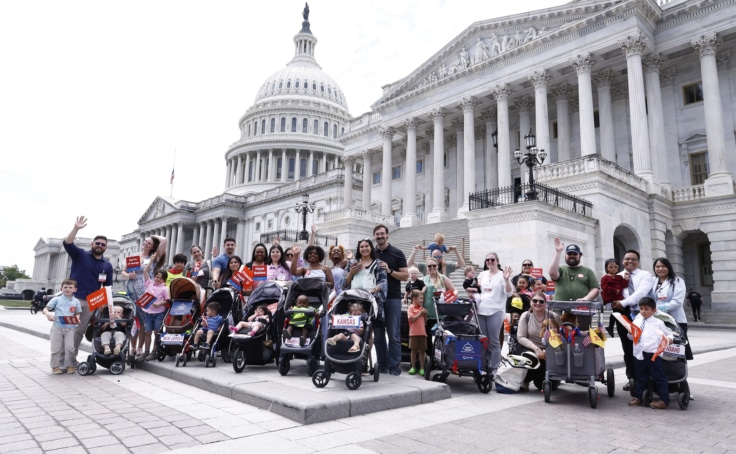
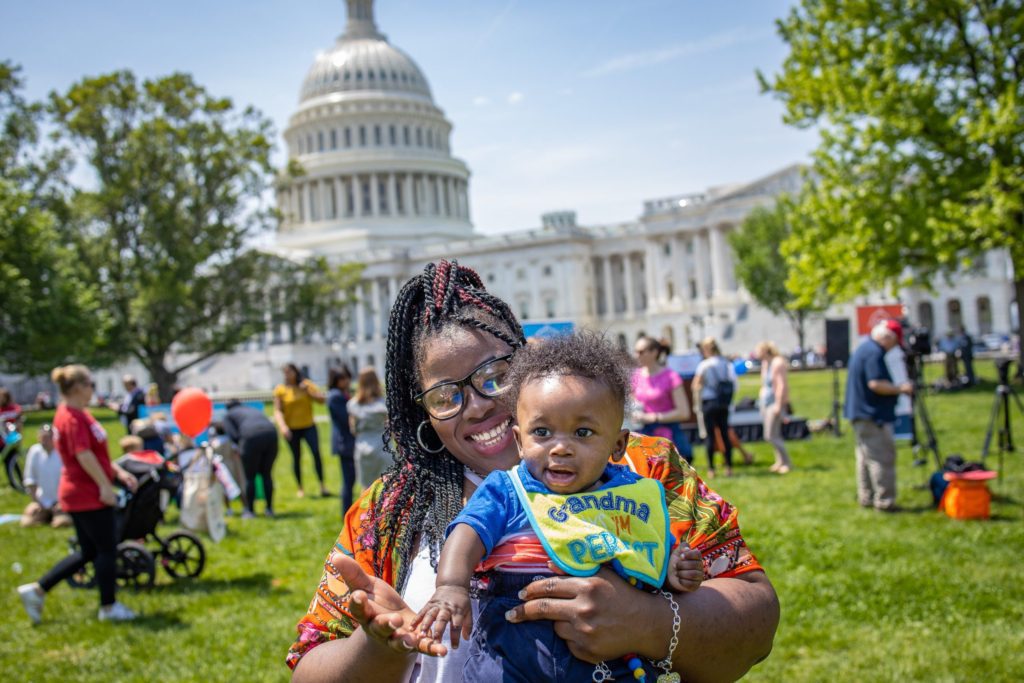
Each year, Strolling Thunder connects families with babies and toddlers from every state and Washington D.C. with their Members of Congress to discuss the policies families need to thrive.
A typical working mom struggling to find child care, Amy joined Strolling Thunder and took her story to Capitol Hill to encourage Congress to Think Babies.