
6-Month Developmental Milestones: What to Expect

Key Takeaways
- Look for growing connection. Familiar faces, shared laughter, and little “conversations” are important parts of development.
- Make room for movement. Supervised floor play gives your baby opportunities to reach, push up, and practice rolling.
- Sitting is still developing. At six months, babies may use their hands to help balance. Sitting independently comes later for many babies.
- Everyday moments count. Talking during diaper changes, sharing a book, and responding to your baby’s sounds all support learning.
- Bring up concerns early. If your baby is missing a milestone, loses a skill, or something concerns you, talk with their provider.
Six-month-olds have so much to share—a squeal, a reaching hand, a smile when you walk into the room. Your baby is discovering new ways to move, explore, and connect with you.
You may also be wondering, “Should my baby be sitting already?” or “Are we doing enough tummy time?” Every child grows at their own pace. Development is never a race. Knowing what to look for can help you enjoy your baby’s discoveries and bring questions to their health care provider.
Below, you’ll find six-month milestones and simple ways to support them. For more ideas for playing together, explore ZERO TO THREE’s milestone kits with age-appropriate play materials.
6-Month-Old Developmental Milestones at a Glance
Here are some skills and everyday experiences you may notice around six months. The vision and hearing row offers things to observe during play; it is not an additional CDC milestone category.
| Developmental Area | What your baby can do | what you can do |
|---|---|---|
| Physical and Movement | • Rolls from tummy to back • Pushes up on straight arms during tummy time • Leans on hands for support when sitting | Offer supervised floor play and stay close when your baby practices sitting. |
| Vision and Hearing | • Watches interesting objects and faces • Listens to familiar voices and nearby sounds | Bring your face into view, name what your baby notices, and leave pauses for a response. |
| Communication and Language | • Takes turns making sounds with you • Makes squealing sounds • Blows raspberries | Copy a sound, pause, and let your baby take another turn. |
| Social-Emotional Development and Bonding | • Recognizes familiar people • Laughs • Enjoys looking at their reflection in a mirror | Share smiles and games, and comfort your baby when they need you. |
| Cognitive and Sensory Development | • Reaches for a toy they want • Explores objects with their mouth • Closes their lips to show they do not want more food | Offer safe objects to explore and respond to your baby’s cues. |
Physical and Movement Milestones at 6 Months
Six-month physical and movement milestones include rolling from tummy to back, pushing up on straight arms during tummy time, and leaning on hands for support while sitting. Your baby is also practicing reaching and grasping through everyday play.
“I’m learning how my body moves. Give me a safe place to practice—with you nearby.”
Your baby’s movements are becoming more purposeful. A toy that once caught a passing swipe may now inspire a determined reach. Watch how your baby opens their fingers, grasps an object, and brings a hand toward their mouth.
During awake time, offer space on the floor to stretch their arms and legs. Stay beside your baby in a sitting position and support them as needed. Let them practice without pulling them into a position they cannot manage.
- Get down together. Place yourself at your baby’s eye level during tummy time.
- Make reaching inviting. Hold a safe toy nearby and give your baby time to try.
- Keep practice comfortable. If your baby becomes upset or tired, take a break.
For ways to make short sessions more engaging, try these tummy time tips.
Should My Six-Month-Old Sit Independently or Roll Both Ways?
Independent sitting is not a required six-month CDC milestone; it appears on the nine-month checklist. The six-month rolling milestone is tummy to back, rather than rolling in both directions.
Some babies show these skills earlier. That does not make them a goal you need to hurry your baby toward. Offer opportunities to move, notice what is changing, and discuss questions with their provider.
Vision and Hearing at 6 Months
At six months, your baby uses vision and hearing to explore faces, objects, voices, and other sounds. During everyday play, you may notice them watching an interesting toy or responding to a familiar voice. These observations complement the milestone checklist rather than form a separate CDC milestone category.
“There’s so much to notice. Help me explore one thing at a time.”
Your face, a moving toy, and a familiar song can make ordinary moments interesting. Notice where your baby looks and how they respond when you speak.
You might say, “You’re looking at the red cup. Here it is.” Move it slowly and give your baby time to watch. During a quiet moment, talk from nearby and observe their response.
You do not need flashing toys or a constant stream of entertainment. Turn off background television during play so you can hear each other. Your voice and attention give your baby plenty to explore.
If you are concerned about how your baby sees or responds to sound, share what you have noticed with their provider.

Communication and Language Milestones at 6 Months
Six-month communication and language milestones include taking turns making sounds with you, squealing, and blowing raspberries. These early exchanges help your baby practice communication; meaningful words are not expected yet.
“My sounds are part of our conversation. When you answer, I learn that you’re listening.”
A squeal can become the beginning of a back-and-forth exchange. Your baby makes a sound. You answer. Then you pause.
Try saying, “You have something to tell me!” Copy their sound or add a few words: “You’re excited to see Nana.”
These exchanges are sometimes called serve and return—your baby reaches out with a look, sound, or movement, and you respond. You can do this while getting dressed, waiting for a bottle, or taking a walk.
- Describe what you’re doing. “One sock, then the other sock.”
- Leave room for a turn. Pause instead of filling every quiet moment.
- Follow their attention. Talk about the toy or person your baby is watching.
Should My Six-Month Old Be Saying Words?
Meaningful words are not expected at six months. Sounds, facial expressions, and movements are your baby’s ways of sharing what they need and how they feel.
Enjoy the conversation as it is. You can answer a cheerful squeal with, “Yes, that was fun!” or a frustrated sound with, “You want that toy. I’ll help you.”
Social-Emotional Development and Bonding
Six-month social-emotional milestones include recognizing familiar people, laughing, and enjoying looking at their reflection in a mirror. Your baby builds connection through shared smiles, playful exchanges, and comfort from trusted caregivers.
“I’m getting to know the people who care for me. Your comfort helps me feel safe.”
Your baby’s relationships are growing. A grandparent’s familiar song or a caregiver’s gentle greeting may bring a smile. Other people may need more time to become familiar.
Your baby’s personality is showing, too. One baby enjoys lots of activity; another needs a quieter place to settle. Notice what your baby seems to enjoy and when they need a break.
What it’s like for you: People may be eager to touch or hold your baby when you are out together. Like Sarita, whose baby Kyle draws plenty of attention, you may sometimes need to set a boundary.
You can say, “He’s taking a break from being held right now,” or “Please wave to him instead.” You can welcome someone’s interest while protecting your baby’s comfort.
Holding, soothing, and responding to your baby help them learn that they can count on you. Comfort does not spoil a baby.
Helping Your Baby Feel Comfortable With a New Caregiver
Leaving your baby with someone new can bring up feelings for both of you.
- Spend time together first. Let the caregiver join you for a familiar activity before your first outing.
- Share what helps. Explain your baby’s feeding routine, tired signals, and favorite ways to be comforted.
- Keep your goodbye warm and clear. “I’m going out. Nana will take care of you, and I’ll come back.”
- Allow time to adjust. A familiar song or routine can help the caregiver connect with your baby.
For more ideas, read about supporting separation anxiety.

Cognitive and Sensory Milestones at 6 Months
Six-month cognitive and sensory milestones include reaching for a toy they want, exploring objects with their mouth, and closing their lips to show they do not want more food. These everyday actions show how your baby learns through exploration and communicates their needs.
“I learn by looking, touching, listening—and putting things in my mouth.”
Cognitive development means learning, thinking, and beginning to solve problems. At this age, that learning happens through hands-on exploration.
Your baby may reach toward an interesting toy, turn it in their hands, or study what happens when it falls. You can name the experience: “You dropped the cup. It landed on the floor.”
There is no need to turn play into a lesson. Give your baby time to investigate, and respond to what interests them.
Mealtimes offer another chance to listen. When your baby closes their mouth or turns away, pause rather than encouraging another bite. Their cues are part of your conversation.

Why Does My Six-Month-Old Put Everything in Their Mouth?
Mouthing is one way babies explore. That includes books—which can make reading feel more like chewing than story time.
You do not have to finish a book or read every word. Point to a picture, make an animal sound, or describe what your baby is touching. Choose sturdy books made for babies and check them for damage.
Keep small objects, loose pieces, button batteries, and magnets out of reach. Offer clean, age-appropriate items designed for baby use, and stay nearby during play.
Simple Activities for a Six-Month-Old
A few minutes of shared play can fit into your day. Choose an activity when your baby is awake and comfortable, and stop when they turn away, fuss, or seem tired.
Tummy Time and Reaching Games
Lie beside your baby on the floor. Put a safe toy nearby or bring your face into view. Say, “Here I am!” and give them time to look or reach.
Supports: Movement, reaching, and connection.
Copy My Sounds
When your baby makes a sound, copy it. Then wait. If they answer, take another turn.
You might say, “Ahh! I hear you.”
Supports: Communication, listening, and turn-taking.
Read a Favorite Book
Let your baby look, touch, and explore a sturdy board or cloth book. Name one picture: “A dog! The dog says woof.”
A page or two is enough if that is what your baby enjoys.
Supports: Early language, shared attention, and bonding.
Mirror Play
Hold your baby beside a securely positioned, baby-safe mirror. Smile, make a face, or point to their reflection.
Say, “There you are! I see your smile.”
Supports: Social interaction and visual exploration.
Popsicle Stick Puppets
For an adult-led game, attach a large picture securely to a craft stick and move it gently while you talk or sing.
Keep the puppet in your hand and out of your baby’s reach. Craft sticks, paper, and glued pieces are not baby chew toys.
Supports: Watching, listening, and shared enjoyment.
"Teeny Tug-of-War"
Make this a gentle grasping game. With your baby lying safely on their back, offer one end of a clean washcloth while you hold the other.
Let your baby grip and explore it. Keep the cloth slack—do not pull their arms or use it to bring them into sitting.
Say, “You’ve got it! We’re holding it together.”
Supports: Grasping, touch, and back-and-forth play.
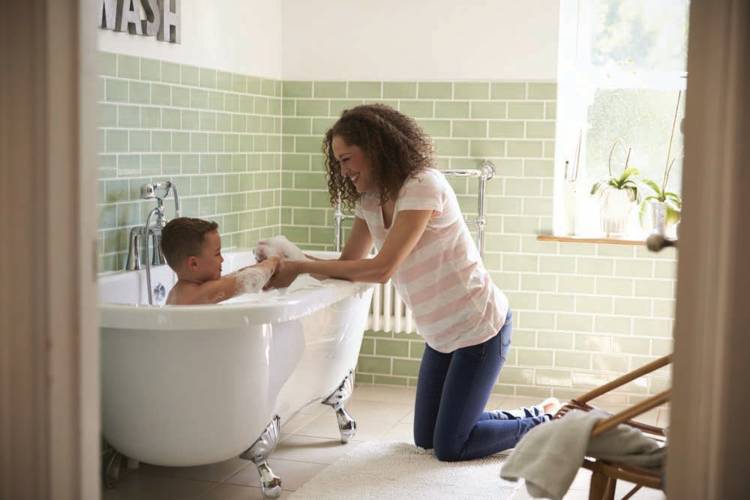
Everyday Bath-Time Learning
Nana turns bath time into connection by singing, naming body parts, and talking about the water.
You can try the same: “Here are your toes. Now your tummy. The washcloth feels wet.”
Keep your baby supported and within reach throughout the bath. Gather supplies beforehand and never leave them alone, even briefly.
Supports: Language, sensory exploration, and bonding.
How Can I Support My Six-Month-Old's Development?
“You don’t have to entertain me all day. Notice what I’m telling you, and we can learn together.”
Small, responsive moments make a big difference. Your baby learns through the care you already provide.
- Follow their lead. If a toy catches their attention, explore it together.
- Name feelings. “That loud sound surprised you. I’m here.”
- Offer comfort. Hold, rock, or speak softly when your baby needs help settling.
- Make space for exploration. Give them safe floor time and simple objects to investigate.
- Let ordinary routines count. Feeding, changing, and getting ready for bed are opportunities to connect.
You do not need a packed activity schedule. Remember to notice what is going well, too. It is okay to feel proud of a new skill—or a good moment together.
What If I'm Too Tired or Overwhelmed to Play?
Some days, the basics take all your energy. Grief, stress, and exhaustion can make connection feel harder.
Start small. Hold your baby close during a feed. Say their name. Rest together while another trusted adult takes care of a task.
If you are struggling, ask someone you trust or your own health care provider for support. You deserve care, too.
Explore the 6–12 Month Play Kit
Want a few materials to help you get started? The 6–12 Month Play Kit includes stacking cups, soft feeding spoons, and a board book for shared exploration. Use them at your baby’s pace: hold a cup together, look at a picture, or explore a new texture.
Explore milestone kits and find ideas for your next moment of play together.

How to Understand Your Baby's Milestones
Developmental milestones are skills that help you notice how your baby is growing. The CDC’s age-based lists describe what at least 75% of children can do by that age. A checklist helps you track development; it does not diagnose a condition or replace developmental screening—a structured check of your child’s development.
You may see one skill happen quickly while another takes more practice. Keep a few notes about what your baby does, what is starting to change, and any questions you want to share.
Learn more about revised developmental milestones and how to use them.
Using Corrected Age for a Premature Baby
If your baby was born early, their provider may use corrected age—their age adjusted for how many weeks before their due date they were born.
For example, a baby who is 24 weeks old and was born eight weeks early has a corrected age of 16 weeks. Corrected age is generally used to understand development during the first two years. Ask your provider which milestones to follow for your baby.

Is My Six-Month-Old Ready for Solid Foods?
Around six months, many babies are ready to begin solid foods alongside breast milk or infant formula.
Readiness involves more than a birthday. Look for steady head and neck control, sitting upright with support, opening the mouth for food, and swallowing rather than pushing food back out. Talk with your baby’s provider about starting foods and choosing safe textures.
Stay with your baby while they eat and follow their signals. “You’re turning away. It looks like you’re finished.”
Sleep and Safety as Your Baby Becomes More Mobile
Night waking can be tiring. You may also notice that your baby’s sleep changes as family routines or daily experiences change.
A familiar wind-down can help: dim the lights, share a book, sing a song, and offer comfort. Ask your provider about feeding or sleep questions that are affecting your family.
Keep these safety practices in place:
- Start every sleep on the back. Place your baby on their back for naps and nighttime sleep.
- Use a firm, flat sleep surface. Choose a safety-approved crib, bassinet, or play yard with a fitted sheet.
- Keep the sleep space clear. Leave out pillows, loose blankets, toys, and other soft objects.
- Use a separate sleep space. After feeding or comforting your baby, return them to their own bed before you sleep.
If your baby can roll comfortably both ways, you do not need to keep turning them back after they roll themselves. Continue placing them on their back at the start of each sleep.
Stop swaddling—wrapping your baby snugly in a blanket—as soon as they show signs of trying to roll.
For reassurance about common expectations, read common myths about baby sleep.

What If My Baby Is Not Meeting a Milestone?
If your baby is missing a milestone, has lost a skill, or you have another concern, contact their pediatrician or other health care provider. You do not have to wait until the next scheduled visit.
- Describe what you notice. “I’ve noticed that my baby…” gives you a place to start.
- Bring examples. Share your notes or a short video of the behavior that concerns you.
- Ask about screening. You can say, “Would a developmental screening help us understand this?”
- Ask about next steps. If concerns remain, discuss whether an evaluation is needed.
In the United States, you can also contact your state or territory’s early intervention program—services that support young children with developmental needs. For children under three, families can request an evaluation without waiting for a diagnosis or a doctor’s referral.
Asking for help is one way you care for your baby.
What Comes Next After Six Months?
Over the coming months, your baby may begin sitting more steadily, passing objects between hands, and making longer strings of sounds. These are among the skills on the CDC’s nine-month checklist.
Later, you may notice new ways of getting around or that your baby pulls up to stand. Walking belongs to a later stage; your six-month-old does not need to practice being a toddler.
Continue making room for safe exploration and shared play. For the next chapter, explore what to expect at seven months.
Your baby’s development unfolds through many ordinary moments. A familiar voice, a comforting hold, an answer to a little sound—these moments tell your baby, “You matter to me.” That relationship is the foundation you keep building together.
What’s on Your Mind? Questions From Parents of 6-Month-Olds
There has been a lot of attention recently on the importance of reading and the critical role it plays in helping a child succeed in school. Clearly you are actively promoting these skills by introducing your 6-month-old to the joy of books. She, in turn, is showing you how much she likes them: by chewing and mouthing their pages.
Babies explore the world through their senses—using their eyes, hands, and mouths. Mouthing is not only normal, it’s one of the first and most useful ways that babies gather information about the shape, size, and texture of the objects in their world. Books, with their bright colors and flapping pages, are especially fascinating, so your daughter is doing all she can to learn more about these funny and delightful square things.
Some parents wonder why it is important to read to a baby who is not even using words yet. But it is actually in these early months and years that the foundation for talking and reading is being built. As you read to your child, she is learning to tune into the sounds of her home language and is becoming familiar with the rhythm of speech. And hearing words over and over helps her eventually learn their meaning.
Reading also nurtures a love of and interest in books. The goal at this age is for book exploration to be a pleasurable and positive experience that makes your child eager to keep interacting with and learning about books. So go ahead and give your child chunky board books or soft cloth books that she can safely explore and chew on. Offering these kinds of books will limit your having to say “No,” or having to take the book away, which can lead to negative feelings about books. Until she is a little older and can safely handle paper pages, you may want to keep that treasured copy of Goodnight, Moon out of reach.
You’ve already taken the most important step by tuning in to the fact that your daughter is slow-to-warm-up to new people. Plus, it is common for babies this age to cling because they are beginning to understand the difference between the people they know and those they don’t.
If possible, invite your babysitter to come over and spend time with your child, while you are there, before the wedding. Feeling comfortable with this new person in her life can be very helpful and ease the transition. This gives your daughter a chance to get to know the sitter in the safety of your presence. It will also give you a chance to talk about how you care for your daughter, including the way she likes to be held and fed, what upsets her, and how to soothe her.
On the night you’re going out, ask the sitter to come to your house about a half hour before you plan to leave to give your daughter time to feel more comfortable with her. When the sitter arrives, sit down with her and your baby for a few minutes and get involved in an activity, such as playing with toys or looking at a favorite book. That way, when you leave, your daughter and the sitter will already be engaged.
When you head out the door, it’s important that you say good-bye. Avoid the temptation to sneak out. While she may still cry at your departure, saying good-bye tells your child she can count on you to let her know what’s going on, and that she doesn’t have to worry that you’re going to disappear without warning. Say your good-bye with a cheerful tone, smiles, and warm hugs. If you have a worried look on your face and a quivering voice, the message you are sending is that you don’t feel good about leaving her and that there is something to worry about. If you’re concerned about how your daughter is doing, call the caregiver a little while after you leave to check in.
Losing a parent is hard at any time, but losing a mother when you have just become a parent yourself can be particularly painful. What you are experiencing—loss of energy and interest, lack of pleasure in what was once joyful to you—are very normal symptoms of grief. Your inability to interact with your child in a way that once came so easily is common.
What a challenging time this must be for you. You are a child, mourning and missing your mother. At the same time you are a parent who is responsible for taking care of the needs and feelings of a young child. The fact that in the midst of your suffering you are able to think about your child is very important because it opens the door to finding ways to meet both your need and your baby’s needs.
Your concern about your child’s development is valid. At this age, children are building their attachments to people. These early relationships lay the foundation for developing healthy, positive attachments in the future. Babies are sensitive to what’s going on around them, especially to their mother’s moods and to any changes in their world. Your baby is likely experiencing his own loss as you are not the Mommy he has known, the Mommy who used to play and laugh with him a lot. This can lead to babies feeling sad themselves and becoming more irritable, clingy, and demanding.
Research shows that what matters most to the baby over the long run is how long the mother’s grief reaction or depression lasts. During this period, you will be sad and it is normal and necessary to mourn. So it is important for both you (and therefore your baby) to get the support you need to cope with and work through this terrible loss. For most, it is too much to go through on one’s own, which is why it is very important that you seek professional help. There are grief counselors specially trained to help. You can contact your local mental health agency for referrals or talk with your health care provider. Also, check your newspaper for support groups for women who are coping with loss. They can be useful as well. Talking with friends and family is important and can be helpful, too, but it does not replace professional help.
To make sure your son’s needs are met during this time, ask your husband or partner to help out more. Ask a family member or a babysitter to come in a few times a week to care for and play with your son and to give you a break. Do one or two activities with your son that require less energy, for example, reading or taking walks together. And try to see your time with your son as an opportunity to keep your mother’s spirit alive. Do you have special memories of singing a particular song or reading a book with your mother? Did your family have any cherished family traditions, like pancakes every Sunday? Think about introducing these into your family’s daily routines and rituals. You may even find some comfort in repeating these loved traditions from childhood with your own baby.
This is a very difficult time. It is important that you continue to think about and take care of yourself and your baby, and ask for the support of friends, family, and trusted professionals.
