

Home/Resources/Early Development/Toddlers and Challenging Behavior: Why They Do It and How to Respond

Toddlers and Challenging Behavior: Why They Do It and How to Respond

The year between age 2 and age 3 is an exciting one. Toddlers are realizing that they are separate individuals from their parents and caregivers. This means they are driven to assert themselves, to communicate their likes and dislikes, and to act independently (as much as they can!). Toddlers are also developing the language skills that help them express their ideas, wants, and needs.

At the same time, toddlers do not understand logic and still have a hard time with waiting and self-control. In a nutshell: Two-year-olds want what they want when they want it. This is why you may be hearing things like “no” and “me do it” and “no diaper change!” more than ever before. Try the strategies below to cope with challenging behavior in toddlers.

Key Takeaways

  • Toddlers are not yet able to stop their impulses.
  • Caregivers should keep calm, validate the child’s feelings, give choices, look for patterns, and direct toward acceptable behavior.
  • A big emotional response, punishment, shaming, bargaining, or demanding an apology will not help.

Learning to Handle Challenging Behavior in Toddlers

As a parent or caregiver, your job is to help your young toddler navigate the tide of strong emotions she is experiencing this year.

This is no small task, because the emotional lives of 2-year-olds are complex. This year they are beginning to experience feelings like pride, shame, guilt, and embarrassment for the first time.

Older toddlers are a lot like teenagers. Their feelings may swing wildly from moment to moment. They may be joyful when getting a popsicle and then despair when it drips on their hands. When experiencing challenging behavior in toddlers, they need your loving guidance to figure out how to cope with their emotions.

Your child is struggling with this when:

  • He has a meltdown when you can’t understand his words
  • She says no when she means yes (you are offering her a favorite treat)
  • He gets so angry that he might throw a toy
  • She cannot settle for a substitute—if the purple pajamas are in the wash, she is inconsolable (even though you have offered the pink ones, the polka dot ones, the ones with the cupcake patch on the front, etc.)
  • He acts out when frustrated—will give up or get angry when he can’t figure out how to make the jack-in-the-box work

Your child is learning to manage strong feelings when they:

  • Use words or actions to get your attention or ask for help
  • Talk to himself in a reassuring way when he is frustrated or frightened. For example, he might say to himself, Daddy will come back, after you drop him off at child care. Or, I can build this again after his block tower collapses
  • Re-enact a stressful event, like a doctor’s visit
  • Use words like I’m mad rather than throwing or hitting
  • Tell you the rules or shows that she feels badly about breaking rules. For example, your child might say no to herself as she does something off-limits, like opening the fridge. Or he might tell you at the park, Don’t walk in front of the swings.

Practicing Self-Control with Toddlers

When you see challenging behavior in toddlers, it usually means that the child can’t figure out how to express their feelings in an acceptable way or doesn’t know how to get a need met.

What helps your child learn is when your response shows her a different, more constructive way to handle these feelings. Learning to cope with strong feelings usually happens naturally as children develop better language skills in their third year and have more experience with peers, handling disappointment, and following rules.

Young beautiful teacher and toddlers playing meals using plastic food and cutlery toy at kindergarten

Although children won’t completely master self-control until they are school-age (and practice it all their lives!), here are some ideas for helping your toddler begin to learn this important skill:

Talk about feelings and how to cope.

Read books and notice aloud how the characters are feeling: The dog is really happy that he got a bone. And share your own feelings: I just spilled the baby’s milk. I feel really frustrated! Will you help me wipe it up? Wow, it feels so good to have your help. When your child can label how he is feeling, it helps him gain control over his emotions and communicate them to others.

Once your child has named his feelings, you can suggest what he might do to feel better or solve the problem. This helps him learn what to do in the future when he faces a similar challenge. For example, if he is sad because his grandparents just left after a 2-week visit, you can suggest looking at photos of them or drawing them a picture.

Offer ideas for how to manage strong emotions.

Young children need guidance when it comes to figuring out how to deal with big feelings like anger, sadness, and frustration. So when your child is really angry, validate what he is experiencing: You are really angry right now because I said no more television.

Then suggest that he jump up and down, hit the sofa cushions, rip paper, cuddle up in a cozy area for alone time, paint an angry picture or some other strategy that you feel is appropriate. What’s important is to teach your child that there are many options for expressing his feelings in healthy, non-hurtful ways.

Empathize with the child.

It’s okay to let her know that you understand the choices she is being offered are not the ones she wants: We have to leave now to go to Ms. Kelly’s house. I know you want to stay home with Daddy. You miss me and I miss you during the day. But staying home is not a choice today. Daddy has to go to work. But when we get home, we will finish the puzzle we started and have a yummy dinner. Do you want to get into the car seat yourself or do you want me to put you in?

Give your child a visual to make waiting easier.

If your child has to wait until his oatmeal has cooled down, show him the steam rising from the bowl. Tell him that when the steam goes away, you can test the oatmeal on a spoon to see if it is cool enough. If you need to help your child brush her teeth for 2 minutes each day, use an egg timer so she can watch the countdown. Need 10 minutes to fold some clothes? Set a kitchen timer so that your child can keep track.

Timers are also great tools for helping children learn to share. Give them each a few minutes—using the timer—to play with a toy they both want, like the shiny new tricycle parked out back. It’s also helpful to state the obvious: It’s hard to wait sometimes, isn’t it?

Let your child make age appropriate choices.

Some examples include: what to wear (perhaps offer 2 choices) and what to eat (within reason), what to play, who to play with. This gives her a feeling of control and supports her growing confidence and sense of competency (the belief that “I can do it”).

Offering choices also helps head off the “Not That One” game where you keep offering your child different things and he keeps saying “Not that one, the other one!” Instead, try giving your child 3 choices and let him pick: You can have an apple, a string cheese, or a bagel for snack. What sounds good to you?

Look for ways to help children practice self control.

There are many daily moments when you can teach your child this skill. For example, games that require turn-taking are great for practicing how to wait and share. Rolling a ball back and forth is an example. This game gives children the chance to wait and control their impulse to grab the ball. You can also take turns hitting a soft foam ball off a tee.

Or try acting out a story. Pretend play offers many chances to wait, take turns, and negotiate as children decide how the story will unfold. Another idea is playing “sharing music” where each of you chooses an instrument to play and set an egg-timer for 1 minute. When the timer goes off, switch instruments and set the timer again.
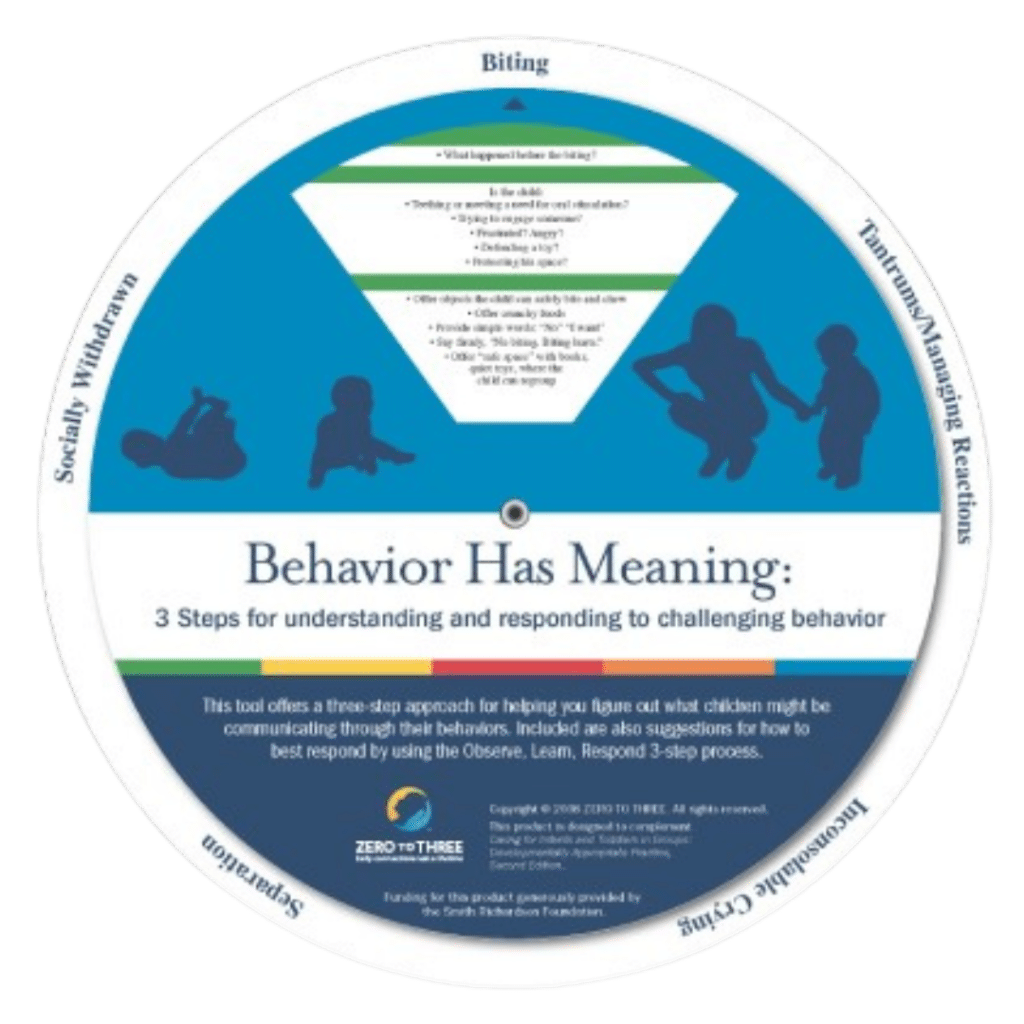
An interactive, 3-step approach to understand and manage behaviors such as biting and tantrums.

Package includes 10 bilingual (English and Spanish) wheels. Bulk discounts are available for purchases of multiple sets! 

Tips to manage these tough behaviors:

Keep calm.

One of the most important things you can do when your child is acting out is to stay calm yourself.

Stop the behavior.

For example, take your child’s hand—firmly but not roughly—and tell them, at eye level, “No hitting. Hitting hurts,” in a serious but calm voice.

Validate your child’s feelings.

Say, “You are angry that Pablo took your toy. It’s okay to feel angry. But I will stop you from hitting. Hitting hurts.”

Give choices.

Tell and show your child what they can do.Teach them better ways to direct their energy. If you stop your child’s behavior, but do not tell them what to do instead, they may keep doing the thing you want them to stop. Tell them they can say “I’M MAD,” jump up and down, stomp their feet, or hit the sofa cushions.

Look for patterns.

Using your child’s behavior as a clue, notice what times or interactions are stressful for your child. That way, you can predict when a blow-up might happen. You might figure out that your child melts down every time they need to get in their car seat. Once you know this, you can offer support. You might give them five minutes of notice before you leave the house. Or they can choose a special book or toy to bring in the car to make the transition easier.

Point out what happened.

There are many natural consequences to actions. Explain what happened. Say, “When you hit Carrie, it hurt her and she started to cry,” or, “When you threw the toy on the floor, it broke.”

Offer an acceptable behavior.

Help your toddler express their wants in a way that’s OK to you. Offer an alternative. Say, “It’s not okay to throw blocks. Someone might get hurt. You can throw these foam balls in the basket instead.”

Some things that won’t help:

A big emotional response from a caregiver.

The more upset you are and the more attention you give a behavior, the more likely the behavior will continue. This is because a big reaction—positive or negative—gets your child’s attention. That alone can be a reason they repeat the behavior.

Punishment.

Consequences given at this age don’t help much. Young children are still learning the rules and how to manage their behavior. Punishing can be scary for them, and fear doesn’t help them learn. Punishment also doesn’t teach children what they should do instead of the unacceptable behavior.

Shaming.

When a child is shamed for behavior they cannot yet control, they will only feel worse. Feeling worse will not improve their behavior or ability to self-regulate.

Too much bargaining.

When a child is allowed to negotiate often, they learn that it’s an effective way to get what they want. Having consistent rules helps children feel safe and secure.

Demanding an apology.

Toddlers who are asked to say “sorry” without fully understanding what they’ve done wrong, do not learn from their actions. It helps if you point out what happened during a calm moment—“When you hit Kennedy this morning, it hurt her and she started to cry.” Over time, they will start to understand the consequences of their actions. Someday they will make a heartfelt apology. It helps when parents model how to apologize and take responsibility for their actions too.

One last reminder to help you get through challenging times is to know you are not alone. Many, many toddlers have difficulty expressing their feelings in acceptable ways (and sometimes lash out at others). When your children challenge you, you may feel like you’re the only one, but that’s not the case. Every parent struggles with limit-setting at times. Knowing that challenging behavior is a typical part of toddlerhood can help you stay steady in the face of whatever your child serves up.

Advertisement
Advertisement