
Two-Month-Old Milestones: What to Expect in Month 2
Key Takeaways
- At 2 months, babies may become more alert and begin showing emerging skills such as social smiling, cooing, watching faces, following nearby objects and briefly lifting their head during tummy time.
- Every baby develops at their own pace. Milestones are useful for observing development, but they are not deadlines
- Follow your baby’s cues and give them a break when they seem overstimulated.
- Talk with your baby’s healthcare provider if your baby loses a skill, is not showing several expected milestones, responds unevenly with their body, does not appear to respond to sights or sounds, or if you have other concerns
At approximately 8 weeks, you may notice your 2-month-old baby becoming more alert and engaged. Your baby may look at your face, smile when you interact, make sounds other than crying, watch nearby people or objects, and briefly lift their head during tummy time.
Many babies begin having longer periods of alertness during the second month, although sleep and wake patterns vary.
Babies develop at their own pace, so these skills may emerge at slightly different times. The Centers for Disease Control and Prevention (CDC) uses “most babies” to describe skills that at least 75% of children can do by a particular age. These guidelines can help caregivers notice certain milestones across physical, communication, cognitive and emotional development.
Below, explore the social-emotional, communication, cognitive, and physical developmental milestones that may shape your baby’s development during Month 2.
2-Month-Old Milestones at a Glance
Development is not a race. Some skills may emerge before or after the 2-month mark. If you are concerned about your baby’s development or notice that they have lost a skill they previously demonstrated, speak with their healthcare provider.
| Developmental Area | What You May Notice | How You Can Support Your Baby |
|---|---|---|
| Physical & Movement | • Holding or briefly lifting the head during supervised tummy time • Moving both arms and legs • Opening the hands briefly • Bringing the hands toward the face or mouth • Movements that may still appear jerky | • Offer short periods of supervised tummy time while your baby is awake. • Provide safe opportunities to move. • Continue supporting your baby’s head and neck. |
| Vision & Hearing | • Watching a caregiver move • Looking at a toy or face for several seconds • Beginning to follow a nearby moving object • Reacting to loud sounds • Becoming attentive to familiar voices | • Hold your baby close during face-to-face interaction. • Slowly move your face or a high-contrast object. • Talk or sing in a gentle voice. |
| Communication & Language | • Making sounds other than crying • Producing early coos or vowel-like sounds • Listening to voices • Participating in brief exchanges through gaze, sound or movement | • Talk, read and sing during everyday routines. • Respond positively to your baby’s sounds. • Pause to give your baby time to react. |
| Social-Emotional & Bonding | • Looking at a caregiver’s face • Appearing pleased when a familiar caregiver approaches • Calming when spoken to or picked up • Smiling during interaction • Looking away when a break is needed | • Respond warmly to your baby’s signals. • Hold, comfort and cuddle your baby. • Follow their cues about when to interact or rest. |
| Cognitive & Sensory | • Looking at a toy for several seconds • Watching nearby people and objects • Showing interest in faces and high-contrast patterns • Learning through repeated sights, sounds, movements and routines | • Offer simple opportunities to look, listen and explore. • Repeat familiar songs and routines. • Reduce stimulation when your baby turns away or becomes fussy. |
Physical and Movement Milestones at 2 Months
At 2 months, your baby’s movements may still appear jerky or uncoordinated, but they may begin moving their arms and legs more actively. Their hands may remain closed much of the time, although they may open them briefly or bring them toward their face or mouth.
Bringing the hands to the mouth is common at this age and may be a way to explore, signal that your baby is hungry or begin trying to self-soothe. Babies still need caregiver support to calm, however, and are not expected to self-soothe consistently.
During supervised tummy time, your baby may hold or briefly lift their head. Head control is still developing, so continue supporting your baby’s head and neck whenever you hold, carry or reposition them. Steady head control, intentional rolling, sitting independently and reaching accurately for toys are later physical milestones and are not expected at 2 months.
Short periods in different supervised awake positions give your baby opportunities to move and build strength. Tummy time should only happen while your baby is awake and closely supervised.
Vision and Hearing Milestones at 2 Months
Your 2-month-old may spend more time looking at faces and watching nearby people move. They may look at a toy or high-contrast image for several seconds and begin following a slowly moving face or object with their eyes. Visual tracking is still emerging, so it may be brief or inconsistent.
Your baby may react to a loud sound by startling, blinking, becoming still or changing their movements. They may also become more attentive when they hear a familiar caregiver’s voice. There is no need to deliberately make loud noises to test their hearing.
Occasional eye wandering or crossing may still occur at this age. Ask your baby’s healthcare provider if you have concerns about their eye movements, visual attention or responses to sound.
Communication and Language Milestones at 2 Months
At 2 months, your baby may begin making sounds other than crying. These may include early coos, vowel-like noises or small throaty sounds. These sounds will not necessarily happen consistently, and your baby is not expected to say words or respond to their name.
Language develops through listening and responsive interaction. Talk, read and sing to your baby during feeding, diapering, bathing and other routines. When your baby makes a sound, respond positively and pause. They may answer with another sound, expression or body movement, creating an early back-and-forth exchange.
Crying remains an important way for your baby to signal hunger, tiredness, discomfort, overstimulation or a need for closeness. Individual cries do not always have one specific meaning, so consider your baby’s expressions, movements and surrounding circumstances together.

Social-Emotional Development and Bonding
These early emotional milestones develop through responsive relationships. Your baby may look at your face, appear pleased when you approach or calm when you speak to or pick them up. Familiar voices, faces, scents, touch and caregiving routines help babies become comfortable with familiar people.
Some smiles remain reflexive and may occur during sleep or without an obvious trigger. Around 2 months of age, social smiles may begin becoming more consistent. Your baby might smile in response to your face, voice or touch, although the timing varies.
Eye contact may be brief. Babies sometimes look away because they need time to process an interaction or take a break. Allowing your baby to pause and return when ready supports comfortable back-and-forth interaction.
Your baby still depends on caregivers for help calming and regulating their physical and emotional state. Responding with a gentle voice, comforting touch or reassuring hold helps build trust. You cannot spoil a 2-month-old by comforting them.
Cognitive and Sensory Milestones at 15 Months
At 2 months, your baby learns by looking, listening, moving and interacting with people. They may watch you move, study your face or look at a toy for several seconds. They may also begin following a nearby object, although this ability may not yet be smooth or consistent.
Simple repetition helps your baby begin noticing patterns. Familiar songs, words and caregiving routines allow them to experience the same sights, sounds and responses repeatedly. These everyday interactions provide meaningful opportunities for learning without requiring elaborate activities or specialized toys.
Your baby can still become overstimulated quickly. Looking away, closing their eyes, yawning, fussing, crying or making less-organized movements may mean they need a break. Reduce noise or movement, hold them calmly and wait for signs that they are ready to engage again.

How Can You Support Your 2-Month-Old’s Development?
You support your baby’s development through warm, responsive interactions—not elaborate activities or specialized toys. Talking, reading, cuddling, supervised tummy time and following your baby’s cues all create opportunities to practice emerging skills through everyday life and help their brain develop.
Talk, Sing and Have Back-and-Forth Conversations
Talk to your baby while feeding, bathing, dressing, changing diapers or completing household routines. Describe what you are doing, sing familiar songs or play soft music. Your voice does not need to be animated all the time; a soft, familiar voice can be comforting and engaging.
When your baby makes cooing sounds or other sounds, respond positively by smiling, copying the sound or answering with a few words. Then pause and give your baby time to respond with another sound, facial expression or movement. These early exchanges introduce the rhythm of back-and-forth conversation.
Older siblings can join by talking, singing or reading to the baby with close adult supervision. These gentle interactions allow your baby to hear more familiar voices while helping siblings participate in family life.
Read Together From Birth
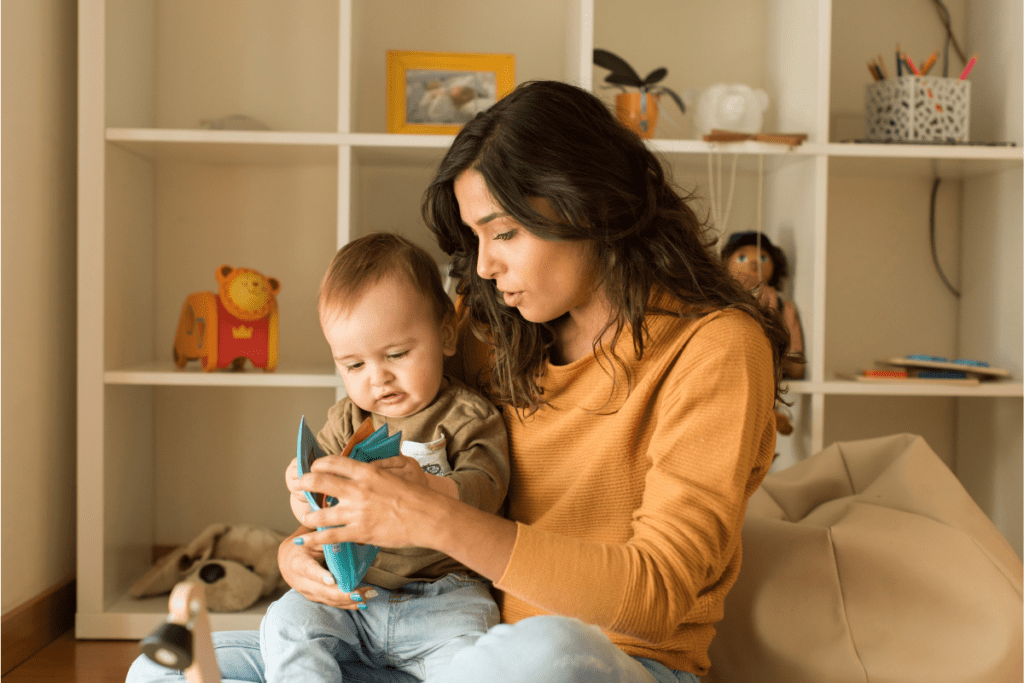
The American Academy of Pediatrics recommends shared reading beginning at birth. Cuddle your baby and explore sturdy board books or soft cloth books with large, simple pictures, bright colors or high-contrast patterns.
At 2 months, your baby will not understand the story or follow every picture. The shared interaction matters more than finishing the book. Talk about what you see, repeat a favorite page or let your baby simply listen to your voice. If your baby looks away or becomes tired, you can stop and return to the book later.
Practice Supervised Tummy Time
Tummy time helps your baby develop the neck, shoulder, arm and trunk strength needed for later physical development. It should only happen while your baby is awake and closely supervised.
Work toward approximately 15–30 cumulative minutes of tummy time each day by about 2 months. Divide this time into several short sessions based on what your baby can comfortably manage. Even a few minutes at a time contributes to the daily total.
If tummy time on the floor is difficult, try placing your baby stomach-down across your lap or chest-to-chest while you recline and remain alert. Stop if your baby becomes tired or upset, and try again later.
Encourage Looking, Listening and Gentle Exploration
Give your baby simple opportunities to explore through sight, sound and touch. Hold your face, a high-contrast image, a book or a safe toy within view and allow time for your baby’s eyes to focus. You can slowly move the object from side to side and watch whether your baby begins following it.
Offer safe textures to touch or gently shake a rattle nearby. Soft music, familiar voices and gentle sounds can also capture your baby’s attention. Avoid shining a flashlight or other bright light toward your baby’s eyes, and do not make loud noises simply to test their reaction.
Watch how your baby responds. Looking away, closing their eyes, fussing or becoming less organized in their movements may mean they need a break. Stop or simplify the activity and try again when your baby appears ready. You do not need a large collection of toys; your face, voice and everyday objects can provide meaningful sensory experiences.
Build Learning Into Everyday Routines
Everyday caregiving offers many opportunities for connection, play and learning. Talk during feeding, bottle preparation, bathing, diapering and dressing. Cuddle, hold or offer skin-to-skin contact when appropriate. These repeated experiences allow your baby to hear language, notice patterns and become familiar with your responses.
Follow your baby’s cues throughout these routines. Rooting or bringing hands toward the mouth may signal hunger, while looking away, yawning or crying may indicate that your baby is tired or needs less stimulation. Bright eyes, sounds and active movement may suggest that your baby is ready to play.
These ordinary interactions are enough to support your baby’s development. Books, toys and other developmental tools can make interaction easier or introduce new ways to play, but they do not cause milestones or determine when a baby reaches them.

Below are some fun ways to interact with your baby in the early months:
Your eight-week old baby may not be able to do a lot right now, but there are several ways that you can interact with your baby.
- Offer interesting objects for your baby to look at. You will see that as you move an interesting object slowly from side to side, your baby will follow it with his eyes. This is called tracking and is one of the first ways that young babies explore the world while building their visual skills.
- Offer interesting objects to touch. You can bring the objects close so your baby can touch them and begin to learn about how different objects feel. This helps her learn through her senses. Exploring objects with eyes, and later hands and mouth, also helps babies discover how different objects work and what they do. This helps your baby become a good thinker and problem-solver.
- Place your baby so that he can kick or hit at a mobile or rattle. Over the next couple of weeks, he will connect the act of kicking with the sounds the mobile makes when struck. This helps him understand cause and effect. Your baby will also discover that making noise is just plain fun.
- Make everyday routines playful. For example, you can add a massage for your baby after baths or before bedtime. Being massaged helps her feel bonded to you and also develops body awareness—the understanding that she is a separate being from others. Share books together, either by reading them to your baby or just letting her gaze at the pictures. In the next few months you’ll start to see your baby take matters into her own hands—grabbing the book and gumming it—while you ask her how it tastes!
Some common “I need a break” signals include:
When you see these kinds of signals, try giving your baby a rest for awhile. Put aside her toys and try rocking and singing quietly to her. If that’s still too much, just hold her. And keep in mind that even eye contact can be very stimulating for young babies, so just snuggling her against your chest may feel best to her. It’s all about trial and error.
- Turns head away
- Back arches back
- Closes eyes/falls asleep
- Fussing and/or crying, making “fussy” sounds, or even hiccupping
If your baby is falling asleep in order to rest from playing, let her snooze. You can also swaddle your baby to give her a break. The idea is to reduce the amount of stimulation—sights, sounds, touches, and movements—that she is experiencing.
This gives her time to calm down and “re-group,” pull herself together. You’ll know your baby is ready to play again when she is calm and clear-eyed, when she meets your gaze, moves her arms or legs, turns toward you, or makes sounds to engage you.
Watching your baby to see how she reacts to, manages, and responds to stimulation gives you very useful information. You can begin to understand what and how much play your baby enjoys, how to recognize when she needs a break, and how to comfort her when she is distressed.
Don’t worry if you don’t get it right immediately. Learning about your baby’s individual needs and temperament takes time. Eventually the two of you will get more “in sync.”

Spotlight on: Playing With Your Baby
Playing…with a tiny baby?! How do you do that with a 2-month-old?
Actually, as babies enter the second month of life, they become noticeably more interested in the world around them. While they don’t “play” in the way that we often think of—pushing trains around a track or feeding a baby doll—they are eager to explore the objects and interact with the people they see every day.
At this age, play is not just about toys, it’s about interaction—anything from singing a song to your baby as you change his diaper, to cooing and smiling back-and-forth with him. Loving and playful experiences like these help your baby learn.
Parents may find themselves confused about their babies’ responses as they play. It’s not uncommon to wonder: We were having so much fun a minute ago, and now he’s crying.
What happened? It’s likely that your baby reached his stimulation threshold and was telling you he needed a break. Babies have their own individual ways of responding to stimulation—light, sound, touch, activity.
Some can take in a lot of stimulation before they top out and become distressed. Other babies get overwhelmed very quickly by what may seem to be just a small amount of stimulation (like brightening the lights in the room). There’s no right or wrong way to be. A baby’s ability to manage stimulation is part of his in-born nature—part of who he is.
Follow the Light
Lay your baby down on his back. Darken the room slightly and shine a flashlight on the ceiling above him. Wait until he has focused on the light and then move the beam gently, slowly back and forth, up and down. Stop if he begins to fuss. Games like this help babies practice focusing their visual attention on objects.
Head and Shoulders Above
Hold your baby with her head on your shoulder. Walk through the house, pointing out interesting objects and talking about them. Encourage your baby to move her head to look up at a mobile, or turn to look out a window. Games like this develop neck, shoulder, and trunk strength.
When Should You Talk With Your Baby’s Healthcare Provider?
Every baby develops at their own pace, and reaching one milestone earlier or later does not necessarily indicate a developmental concern. You know your baby best, so trust your observations and talk with their healthcare provider or another trusted professional whenever something does not seem right.
Talk with your baby’s healthcare provider if you notice that your baby:
- Loses a skill they previously demonstrated
- Is not showing several expected milestones
- Moves one side of their body much less than the other
- Does not appear to respond to sights or sounds
- Shows other signs that concern you
Your baby’s healthcare provider can listen to what you have noticed, observe your baby and determine whether additional developmental screening or support may be helpful. This article and other milestone checklists can help you monitor child development, but they do not replace standardized developmental screening or professional guidance.
If further evaluation is recommended, early intervention can connect eligible infants and toddlers with services that support their development. Asking questions or requesting an evaluation does not mean your baby has a developmental delay—it is simply a way to learn more and access support when needed.

What If Your Baby Was Born Prematurely?
If your baby was born more than three weeks early, corrected age may provide a more useful comparison when considering developmental milestones. Corrected age accounts for the number of weeks between your baby’s birth and their expected due date.
Use this short formula:

For example, if your baby is 12 weeks old and was born 4 weeks early, their corrected age is approximately 8 weeks, or 2 months. Comparing their development with typical 2-month-old milestones may therefore be more appropriate than using their chronological age of 3 months.
The American Academy of Pediatrics generally recommends considering corrected age during the first two years of life. Even with this adjustment, every premature baby develops at their own pace. Your baby’s healthcare team can explain which age comparison to use and offer individualized guidance based on their birth history, health and development.
What Comes Next?
As your baby approaches three months, you may notice continued growth in social interaction, head control, cooing and other sounds, visual attention and increasingly intentional movement. These next milestones develop gradually and at each baby’s own pace. Continue supporting your baby’s development through responsive care, conversation, supervised tummy time and simple play.
Follow the series with Month 3 for guidance about the next stage rather than treating these emerging skills as a checklist your baby must complete now.
Ready for more ways to connect and play? Explore the 0–6 Month Milestone Kit for age-appropriate activities, play tools and guidance designed to support interaction throughout your baby’s first six months.
What’s on Your Mind? Frequently Asked Questions About Two-Month-Old Milestones + Questions From Real Parents
A 2-month-old may briefly lift or hold their head up during supervised tummy time, but steady, unsupported head control is not expected yet. Continue supporting your baby’s head and neck whenever you hold, carry or reposition them.
Some early smiles are reflexive and may occur during sleep or without an obvious trigger. Around 2 months, social smiles often become more consistent, and your baby may smile in response to your face, voice or touch. This skill may emerge gradually over the following weeks.
A 2-month-old can become familiar with frequently experienced voices, faces, scents, touch and caregiving patterns. Your baby may become more alert, appear pleased or calm more easily when a familiar caregiver approaches. This early familiarity is not the same as adult-like recognition, but it supports security and connection.
Rolling over is not an expected 2-month milestone. Some babies may shift or accidentally roll because of their position or reflexive movement, but intentional rolling generally develops later. Continue supporting your baby’s head and neck, and never leave them unattended on a raised surface.
Work toward approximately 15–30 cumulative minutes of supervised tummy time each day by about 2 months. Divide that total into several short sessions while your baby is awake, based on what they can comfortably manage. See the supervised tummy-time section for positions and practical tips.
No. A 2-month-old depends on caregivers for help calming and feeling secure. Responding to crying with a gentle voice, touch or comforting hold does not spoil your baby; it supports trust, connection and emotional development.
At 2.5 months, your baby may show a mixture of established 2-month milestones and skills that continue emerging as they approach Month 3.
Many parents feel exhausted and puzzled by their newborn’s seemingly random sleeping, waking, eating, and pooping schedule. This unpredictability is normal. The first 3 to 4 months of a baby’s life are a transition period as they are learning to adapt to life outside the womb. Getting used to being awake during the day and sleeping at night takes time and help from you.
Babies usually don’t settle into a fairly consistent schedule until they’re about 4 to 6 months old. So the first few months of your child’s life is not the time to expect or to establish a rigid daily schedule.
What you can do is develop some routines around sleeping and eating. This will set the groundwork for establishing a schedule later on. For example, when you see that your baby is getting drowsy, you can sing her a lullaby and then put her down to sleep. Over a period of time, the lullaby will become your baby’s cue for sleeping.
You can also slowly work toward helping your child adapt to a more regular routine by looking for patterns in her behavior. One mother, who was trying to get her 10-week-old to take two or three longer naps a day instead of six or seven catnaps, noticed that her child got very sleepy during feedings.
So she decided to slowly adjust the feeding times to happen when she wanted her baby to nap. She also started trying to keep her daughter awake a few minutes longer before each nap. This meant that her baby would be awake for longer periods during the day, take longer and fewer naps, and sleep for longer stretches during the night.
Many babies establish a fairly regular feeding schedule all on their own. If this isn’t happening for your baby, you might try to stretch out the time between feedings (beginning with just a few minutes) so that feeding times are longer and fewer.
If you continue to do this at each feeding, your baby is likely to eat a little more each time and will be able to wait longer between meals. Once again, remember that babies are not ready for “schedules” until they are 4 to 6 months old so try to be patient with your hungry little caterpillar for the time being.
From “Your Child’s Behavior,” a column written by ZERO TO THREE in American Baby magazine.
Children have different levels of tolerance for stimulation. While some can handle lots of sound and movement all at once, others find it overwhelming. It sounds like your baby is telling you that this mobile is more than he can handle.
One option is to put the mobile away for now and try it again later when your son is a bit older and his neurological system is more mature and stronger. Another is to help your son adjust to increasing amounts and kinds of stimulation by letting him look at the mobile without turning it on—no movement, no music.
When he seems to be calm and enjoying that, try gently moving it so he can see it turn. If he can handle this and likes it, you can try adding the music. Slowly and sensitively introducing him to more stimulation can help him build greater tolerance over time.
This is also an important example of how babies are good communicators, and are skilled (even from very young ages) at letting you know their needs and wants. When you pay attention to your son’s signals and respond in a supportive way, you let him know he is a good communicator, as well as someone who is loved and accepted for who he is.
This gives him the foundation he needs to be a confident, secure person as he grows.
Babies usually don’t settle into a fairly consistent schedule until they’re about 4 to 6 months old. So the first few months of your child’s life is not the time to expect or to establish a rigid daily schedule.
What you can do is develop some routines around sleeping and eating. This will set the groundwork for establishing a schedule later on. For example, when you see that your baby is getting drowsy, you can sing her a lullaby and then put her down to sleep. Over a period of time, the lullaby will become your baby’s cue for sleeping.
You can also slowly work toward helping your child adapt to a more regular routine by looking for patterns in her behavior. One mother, who was trying to get her 10-week-old to take two or three longer naps a day instead of six or seven catnaps, noticed that her child got very sleepy during feedings.
So she decided to slowly adjust the feeding times to happen when she wanted her baby to nap. She also started trying to keep her daughter awake a few minutes longer before each nap. This meant that her baby would be awake for longer periods during the day, take longer and fewer naps, and sleep for longer stretches during the night.
Many babies establish a fairly regular feeding schedule all on their own. If this isn’t happening for your baby, you might try to stretch out the time between feedings (beginning with just a few minutes) so that feeding times are longer and fewer.
If you continue to do this at each feeding, your baby is likely to eat a little more each time and will be able to wait longer between meals. Once again, remember that babies are not ready for “schedules” until they are 4 to 6 months old so try to be patient with your hungry little caterpillar for the time being.
From “Your Child’s Behavior,” a column written by ZERO TO THREE in American Baby magazine.
Children who are in high-quality programs can do very well in child care. Look for a clean and safe setting, with no more than three babies for every caregiver. There should be toys and books at the baby’s level, and child care providers who will let your daughter eat, sleep, and play according to her own individual schedule.
Make sure that the caregivers talk and play with babies, that they comfort them when they are upset, and that they are loving and nurturing. Caregivers should also be able to provide you with daily feedback about your daughter’s day—how much she ate and slept, how many diapers she had, and what and whom she played with.
It’s also important to find a program that welcomes parent participation and communicates regularly with parents. Building a good working relationship with your daughter’s caregivers helps ensure that her needs are met.
Ideally, your daughter would have a “primary” caregiver in her program who is the person primarily responsible for her, while the other caregivers offer back-up care. Having a primary caregiver helps babies thrive as it gives them the chance to build a nurturing connection with an adult who has the time to understand them—their personalities, nonverbal signals, even the way they like to be held, fed, and played with, and how they like to be put to sleep.
This makes babies feel safe and secure. Talk with your daughter’s child care providers to see if they would be open to assigning one of the staff members to be your daughter’s primary caregiver.
You can help your daughter adjust and feel comfortable in her new setting by taking her to meet her caregivers and spending time there so it feels familiar. If you can, plan to stay with her for a while on the first day.
Then, over the course of the first week, gradually decrease your time until you are spending only a minute or two at drop-off. Try as best you can to be positive and relaxed as you say your good-byes.
Even young babies pick up on their parent’s feelings through their tone of voice, facial expressions, and gestures. If you are anxious and hovering, it may increase your child’s anxiety and make it harder for her to separate.
If you are worried about how your daughter is doing during the day, call the center and talk with her caregiver. While it can take time, finding a child care program that you like and trust helps make the transition that much easier for your baby…and you, too.
Seeing your baby unhappy is always tough. But this reaction is not uncommon. Many babies protest at being changed. The experience of going from feeling warm and cozy to being exposed can be uncomfortable. Imagine what being in the womb must have been like—warm and protected, soft and comfy. When your baby finds himself naked and chilly on the changing table, he lets you know he doesn’t like it one bit by crying—his most effective communication strategy!
Certain factors make changing especially distressing for young babies. One is that infants can’t control their body temperature very well. When they’re undressed, the temperature drop feels dramatic, and it takes them longer to warm up once they’re clothed again.
Also, when you change your baby, all different parts of his body are being touched, pushed, and tugged as clothing and diapers are pulled on and off. For babies who are especially sensitive to touch, the experience can be particularly uncomfortable. They show it by pulling away, arching their backs, and crying.
Be sure to plan ahead and make dressing as gentle and quick as possible. Have a clean diaper, baby wipes, and your child’s change of clothes close at hand. Consider using warm diaper wipes or moisten paper towels or a washcloth with warm water. When changing your child, drape a soft towel or blanket over his body to keep him warm. You can also try distracting him with a mobile above the changing table or by singing and talking to him while you change him.
The most important thing you can do is stay calm. When you get upset, your baby senses it in your facial expressions, your voice, and in the way you touch him as you perhaps try to rush to get it over with sooner. This may just get him more worked up. So take a deep breath, and remember, the crying is not about you. Reassure your baby: I understand you don’t like this, sweetie. I’ll just be a few more seconds. I’m putting your pajamas on now. Even though he doesn’t understand your words yet, your soft, loving tone will send the right message.
Make sure that the caregivers talk and play with babies, that they comfort them when they are upset, and that they are loving and nurturing. Caregivers should also be able to provide you with daily feedback about your daughter’s day—how much she ate and slept, how many diapers she had, and what and whom she played with.
It’s also important to find a program that welcomes parent participation and communicates regularly with parents. Building a good working relationship with your daughter’s caregivers helps ensure that her needs are met.
Ideally, your daughter would have a “primary” caregiver in her program who is the person primarily responsible for her, while the other caregivers offer back-up care. Having a primary caregiver helps babies thrive as it gives them the chance to build a nurturing connection with an adult who has the time to understand them—their personalities, nonverbal signals, even the way they like to be held, fed, and played with, and how they like to be put to sleep.
This makes babies feel safe and secure. Talk with your daughter’s child care providers to see if they would be open to assigning one of the staff members to be your daughter’s primary caregiver.
You can help your daughter adjust and feel comfortable in her new setting by taking her to meet her caregivers and spending time there so it feels familiar. If you can, plan to stay with her for a while on the first day.
Then, over the course of the first week, gradually decrease your time until you are spending only a minute or two at drop-off. Try as best you can to be positive and relaxed as you say your good-byes.
Even young babies pick up on their parent’s feelings through their tone of voice, facial expressions, and gestures. If you are anxious and hovering, it may increase your child’s anxiety and make it harder for her to separate.
If you are worried about how your daughter is doing during the day, call the center and talk with her caregiver. While it can take time, finding a child care program that you like and trust helps make the transition that much easier for your baby…and you, too.
You can put your fears to rest. By and large, the research shows that young babies who are fussy are NOT more likely to grow up to be cranky kids.
There are several reasons for fussing in the early months:
– Some babies’ central nervous systems are more sensitive and reactive to stimulation from the outside world. This can cause irritability, because these babies are more likely to experience sensory overload. As they mature over the first 3 to 4 months, they usually become better able to handle all the sights and sounds they’re encountering.
– Your baby might be dealing with reflux, a temporary condition, which occurs when the lower esophageal sphincter muscle, which separates the esophagus from the stomach, is relaxed. This allows acidic stomach fluids to back up into the esophagus, causing an uncomfortable, burning sensation.
– If your baby cries continuously for more than 3 hours, 3 days a week during the first 3 months, she may have colic. (Up to 20 percent of babies have it.) Although the cause is unknown, the condition is temporary and won’t impact your child’s development or personality.
