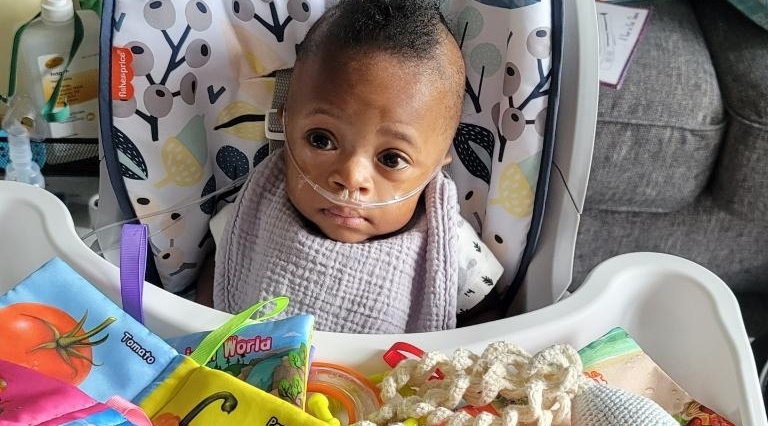
Parent trauma is real. I didn’t know how much of a toll it takes until I was in the middle of it.
Irvin has been fighting since before he was born. Doctors found an enlarged kidney during my pregnancy. After he arrived, came the diagnoses: focal epilepsy, infantile spasms, breathing and feeding difficulties. A kidney with a tumor was removed. And now he has Wilms’ Tumor, a form of kidney cancer. He is just over a year old.
Through it all, Irvin smiles. He reaches up and puts his little hand on your face. He has three teeth now. He hugs you back. Watching him fight keeps our family moving.
LaBaron works 12-hour shifts. I left my job as a teacher’s assistant to stay home and manage Irvin’s care. Our daughters are 8 and 9. They know the signs of a seizure. They have reorganized their childhoods around their brother’s needs, and I am doing everything I can to make sure they still feel seen and mothered, too.
Kentucky’s waitlist for in-person pediatric physical therapy is six to eight months. We couldn’t wait that long; Irvin needs hands-on work. So we drive to Cincinnati. That’s 2.5 hours each way, twice a month, down from once a week when we started. The day after Cincinnati, we often drive nearly two hours to Lexington for his neurology appointment. The gas alone is a real and constant burden. Travel reimbursement exists, but the mileage threshold doesn’t account for families who simply don’t have enough gas money to get across town, let alone across state lines.
We applied for Supplemental Security Income (or SSI), but we were initially denied. We hired a lawyer to help us get approved. One day, just before Irvin’s kidney surgery, I thought to check the mailbox. There was a letter — a meeting scheduled for the next day. If I had missed it, we would have waited six more months. That is how thin the margin is.
We are grateful. We have WIC, the federal Special Supplemental Nutrition Program for Women, Infants, and Children, which helps us get healthy food. We have SSI now. We have family who drove from Louisville to Cincinnati when Irvin had his surgery. We know how lucky we are to have that. But not every family does.
What I want policymakers to see is the whole picture — the long drives, the waitlists, the siblings absorbing everything, the parents putting themselves last.
Parent trauma is real, and it doesn’t get talked about enough. The child is the priority, but parents are the ones keeping everything together.
Irvin keeps fighting. So do we. We just need the systems around us to fight a little harder, too.