
Home/Early Childhood Issue Areas/Early Development/Developmental Milestones Birth to 3 Years: Your Complete Guide With Checklist & Chart

Developmental Milestones Birth to 3 Years

A complete guide with checklist and chart.

From the first smile to those wobbly first steps, your baby’s first three years are full of milestones worth celebrating. Developmental milestones are skills most children reach by a certain age, like babbling, waving or stacking blocks.

Every child develops at their own pace. These milestones are a guide, not a scorecard. They can help you celebrate your child’s progress and know when to ask questions if you have concerns.

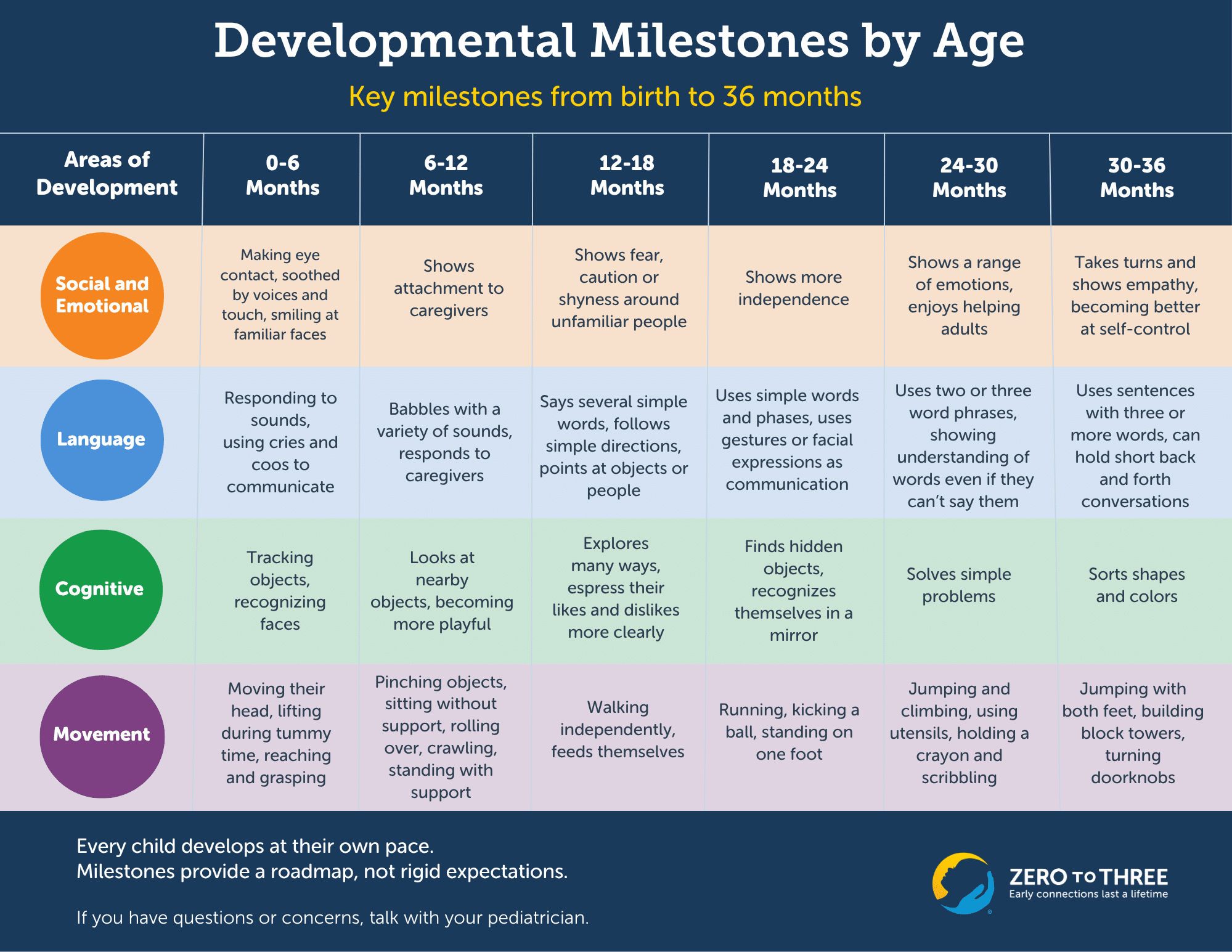
Use the milestone chart for a quick look at what most children do by each age. Then use the printable checklist to track your child’s progress and share it at well-child visits.

The milestones reflect what about 75% of children can do by a given age, based on guidance from the Centers for Disease Control and Prevention (CDC) and the American Academy of Pediatrics (AAP).

Jump To:

    Key Takeaways

    • Milestones fall into four areas: how a child connects, communicates, thinks, and moves.
    • Our milestones chart shows what’s typical by age; the checklist helps you track and share. They work together.
    • Missing a milestone isn’t a diagnosis. But parents know their child best, and it’s always okay to ask your child’s doctor.
    • If you ever have a concern, there’s a clear path: screening, evaluation, and early intervention support if a child needs it. Acting early makes a real difference.


    The Four Areas of Development

    Milestones show up across four connected areas: social and emotional, language and communication, cognitive, and physical development. Your child is usually working on all of them at once.

    Social and Emotional

    These skills describe how a baby connects with others and through back-and-forth interactions and building relationships.

    At first, it looks like locking eyes with you and calming to your voice. Over time, babies will respond to their name, share moments of delight (“did you see that too?”), play alongside other children (parallel play), show empathy for others and take turns. These early bonds are the foundation for everything else.

    Language and Communication

    Long before words, babies are communicating — cooing, babbling, and using gestures like pointing and waving to tell caregivers what they want and notice. 

    This area covers both receptive language (what a child understands) and expressive language (what a child can express). A first “mama” or “dada,” following a simple direction, and stringing two words together are all part of this unfolding.

    Cognitive

    This is a child’s thinking at work: figuring out that a toy still exists when it’s hidden (object permanence), banging two blocks to see what happens (cause-and-effect play), working a simple puzzle and eventually pretending to feed a stuffed animal.

    Play is learning at this age. Through play, children test ideas, solve problems and discover how the world works.


    Movement and Physical Development

    This area has two parts. Gross motor skills use the big muscles (head control, rolling, sitting, pulling to stand and becoming mobile like crawling and walking).

    Fine motor skills use the small ones (bringing hands to the mouth, developing a pincer grasp to pick up a puff of cereal, scribbling with a crayon, and stacking blocks).


    Milestones by Age: Explore Every Month, Birth to 36 Months

    Wondering what to expect this month? Tap your child’s age to see the full picture — what most children are doing, simple things you can do together and what to talk about with your child’s doctor.

    Year One: Months 1–12

    In the first year, your baby changes more than at any other time; from a newborn who calms to your voice to a busy explorer who may be pulling up and cruising. Common first-year moments include the first social smile, rolling over, sitting, babbling and responding to their name.

    Previous
    Next

    Year Two: Months 13–24

    Your baby becomes a toddler during this year. They are walking, pointing to show you things, trying out first words and beginning to play pretend. Around 15 and 18 months are key check-in ages, and by 18 months most children walk on their own and try to say a few words beyond “mama” and “dada.”

    Previous
    Next

    Year Three: Months 25–36

    Your toddler’s world opens up during this year. They are running, climbing, longer sentences and rich pretend play. Toward the middle of this year, many children are combining two or more words like “more juice.”

    Previous
    Next

    Milestones Checklist and Chart by Age

    Download our free, printable checklist and chart to see what milestones are typical at various ages. Keep in mind that these tools are a guide for conversation, not a test and not a developmental screening. Think of it as a way to celebrate new skills and to make it easy to share anything you’re wondering about with your child’s doctor. 

    Advertisement
    Advertisement

    About the Revised Milestones

    The CDC and the American Academy of Pediatrics updated developmental milestones in 2022 to reflect the skills that at least 75% of children can do by a given age. The revised milestones are intended to help identify children who may benefit from additional evaluation or support sooner.

    Some milestones were also updated or removed. For example, crawling is no longer included because healthy babies begin moving in many different ways. Some crawl, some scoot, some roll and some skip crawling altogether. Each of these can be part of typical development.

    When to Check In: Red Flags and Regression

    Developmental milestones are a guide, not a checklist to pass or fail. Children develop at their own pace, and there is a wide range of what’s typical.

    A conversation with a health care provider may be helpful if:

    • A child is not meeting one or more milestones for their age.
    • A child seems to lose a skill they previously demonstrated. Temporary changes can happen as children focus on new developmental skills, work through big emotions or adjust to changes in their lives. But if a skill disappears or concerns persist, it is worth discussing with a health care provider.
    • There are ongoing concerns about a child’s development.

    Noticing one of these signs does not necessarily mean something is wrong. It means a closer look may be helpful. Early identification can connect children and families with support when it is needed.

    Developmental Screening and Well-Child Visits

    Milestone tracking and regular check-ups go hand in hand. At well-child visits, health care providers look at how a child is growing and developing over time. They may also use a developmental screening, a short questionnaire that helps identify whether a child might benefit from extra support.

    The American Academy of Pediatrics (AAP) recommends developmental screening at 9, 18, and 30 months, along with autism-specific screening at 18 and 24 months. Sharing milestone observations and everyday examples from home helps give providers a more complete picture of a child’s development.

    Questions or concerns don’t have to wait until the next check-up. Reaching out to a health care provider early can help families get answers and support when they need it.

    What Happens If There's a Concern?

    If a developmental screening or conversation raises questions, a health care provider may recommend a developmental evaluation. This is a more in-depth assessment that helps identify a child’s strengths, needs, and whether additional support could be helpful.

    Depending on the results, families may be connected with services such as speech-language therapy, a hearing evaluation, occupational or physical therapy, or support for feeding and swallowing challenges.

    Early intervention is designed to provide support during the years when it can have the greatest impact. Throughout the process, caring relationships remain at the center. Everyday interactions with trusted caregivers continue to play the most important role in a child’s learning, development, and well-being.

    ZERO TO THREE's Baby Brain Map

    Our “Baby Brain Map” is designed to educate parents, caregivers, and early childhood professionals about the critical stages of brain development in young children from birth to three years old. 


    This tool provides an engaging, user-friendly way to explore how babies’ brains grow during these formative years, emphasizing the impact of experiences, relationships, and environmental factors on neural development. 

    Related Resources

    Be a Baby Champion

    Explore our science-based resources, attend events and advocate for policies that support early intervention and family engagement so we can ensure every child receives the strong start they deserve. Get involved today or explore our comprehensive resources for more.