
How the attention economy impacts young children
Dr. Radesky explains how today's digital media is capturing and commercializing young children’s attention, underscoring the need for stronger parent, platform, and policy responses.


Dr. Jenny Radesky
Dr. Jenny Radesky is Co-Medical Director of the American Academy of Pediatrics (AAP) Center of Excellence on Social Media and Youth Mental Health, where she helps lead national efforts to advance evidence-based guidance on how digital media impacts children and families. A pediatrician and researcher at the University of Michigan, her work focuses on the intersection of technology use, parent-child relationships, and child social-emotional development.
The attention economy
Kids’ media has changed dramatically since the era of Saturday morning cartoons.
As a child of the 80s, I sat with my brothers on Saturday mornings, watching what every other child in the US was offered – a mix of cartoons, super heroes, and cereal or toy commercials. But it’s drastically different today. Children have always been the object of marketing pressure, but today’s under-fives face a barrage of commercial interests designed to influence their viewing and buying patterns, starting in infancy.
In my 15 years of researching children’s media use, the “attention economy” (the business models and designs that capture, track, and monetize users’ time and attention) – has never been more prominent in the media that children consume.
Social media content creators have identified the most effective ways to capture and sustain attention, which supports their end goal: generating more ad revenue.
Like adults, whose attention is pulled in myriad directions by news, social media, and information overload, children’s attentional systems are being strained by digital platforms that are designed to enchant, captivate, and shape their perceptions of the world. These include: mesmerizing nursery rhymes, kid influencers unboxing toys and pranking their parents, and plasticine families leading their perfect lives. Social media content creators have identified the most effective ways to capture and sustain attention, which supports their end goal: generating more ad revenue. Young children’s attention, in particular, has been described as a “demand that never goes away” – if you know any exhausted parent of a 2-year-old, you know that’s true.
The American Academy of Pediatrics has offered positive support for parents, such as tips for finding better content, offline activity ideas, and suggestions for how to help your child calm down in screen-free ways. We recommend child-centered digital content producers like PBS KIDS and Sesame Workshop, who know that when videos tell meaningful stories and don’t overload children with rapid scene changes or audiovisual effects, children can learn and transfer skills from screens to the physical and social world around them.
But creators who want to use children’s attention as an extractable, monetizable resource do not put this type of care into their content and instead “bedazzle” it with or attention-grabbing gimmicks. And now, the prime offenders of the attention economy – short-form videos and AI slop – are now directed squarely at young children, and it’s time to draw the line.
The prime offenders of the attention economy – short-form videos and AI slop – are now directed squarely at young children, and it’s time to draw the line.
AI-generated content:
Content creators compete for engagement on social media platforms and they’ve realized that AI slop is another way to capture attention.
AI slop is AI-generated images or videos with visually engaging or bizarre qualities that are hard to look away from. Creator Carla Engelbrecht reviewed some of these in a recent video and substack post on the topic – she points out many limitations and low quality, such as a math video where the lyrics say “eight” but there are ten forks on screen. In the worst cases of AI-generated nursery rhymes or kid-directed brain rot, there is no creative human with developmental knowledge behind the screen creating a meaningful story. There is just an AI platform, instructions to create some type of “child-directed” content, and the market-driven goal of creating something just engaging enough to hold a child’s attention until the ad comes on the screen. With all of the kids’ ad space to fill on platforms, content farms see short-form video and AI slop as a profit opportunity, one that is exploitative of children’s time and attention. I worry that it habituates children to expect attention capture and meaninglessness in their media.

Fundamentally, AI slop is also exploitive of young children’s developmental vulnerability, including their trust in the content placed before them. It exploits their brain plasticity, the early flexibility of the developing brain to wire itself based on the inputs it receives. This means young children are uniquely open to manipulation and neurologically primed to accept the reality they are viewing on the screen.
AI slop exploits children's brain plasticity, the early flexibility of the developing brain to wire itself based on the inputs it receives.

Short-form video:
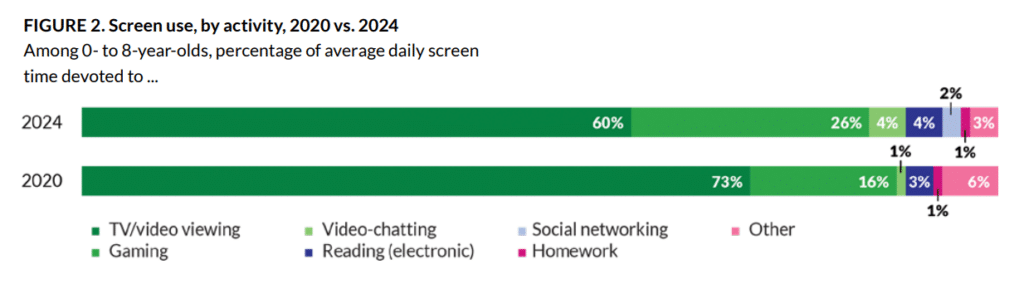
Data from Common Sense Media found that children 8 and under are increasingly consuming short-form content, such as TikTok videos, Instagram Reels, or YouTube Shorts.
I’ve seen it in my clinic or when out in public. It’s hard for young kids to look away from the nonstop feed of novelty, but I worry about the costs in terms of their attention regulation. In adults, a systematic review of 71 studies found that increased short-form video use was associated with weaker attention and self-control. Heavier short-form video-using adults also had higher stress and anxiety, perhaps because they go to short-form feeds to quell their distress, or maybe because an incoherent feed of attention-grabbing content can leave you feeling mentally disorganized.
Short-form video is advantageous to platforms because it allows them to put more ads in front of users, collect data about what grabs their attention (which reflects our “fast-brain” impulses, not our slower, deliberate thinking), keep users on longer through endless scroll, and use algorithmic recommendations to predict what users will stay on to watch next. Many adults can’t resist these design features (and I’ve talked with countless parents who stay up too late scrolling). Why would we expect young children, with their developing attentional control networks, to resist?
What can we do?
Parents can take a break (for themselves and their children) from platforms that serve up short-form video or AI slop, as an act of resistance.
In essence, they can refuse to allow their child’s attention to be mined for ad dollars. If parents want a free video alternative, they can install the PBS KIDS video app on smart TVs or mobile devices. When out and about in the car or community, parents can bring other on-the-go activities, like activity books or things to read. Kids don’t need “snackable content;” they need practice learning how to tolerate everyday moments of downtime, waiting, or participation in family events.
The biggest responsibility lies with the platforms that control the incentives and policies about how content can be recommended and monetized on their sites. If platforms like YouTube start clearly labeling and stop recommending and monetizing AI-generated content, there will be a diminished market for it. Children and adults deserve to have a “no AI content” toggle on their video feeds so that they can opt out of this form of attention capture. Child-directed platforms can remove AI-generated slop altogether. Platforms and content creators can stop offering short-form video for kids, out of respect for their attention span.
Parents shouldn’t be the only ones responsible for managing their child’s exposure to AI slop and short-form content. While federal regulation and industry action around child-directed content has remained lax, I think prevention is the best medicine. Let’s collectively turn it off.

Next Up
Go to Next ResourceChoosing Media Content for Young Children Using the E-AIMS Model
The E-AIMS model helps you set your sights on programming that is: Engaging Actively Involved Meaningful Social Use this flow chart to help you make decisions about screen time.
