Why I Use AI to Monitor my Baby

A new mom shares her experience with AI baby monitors and how they can lighten the mental load or fuel new worries.
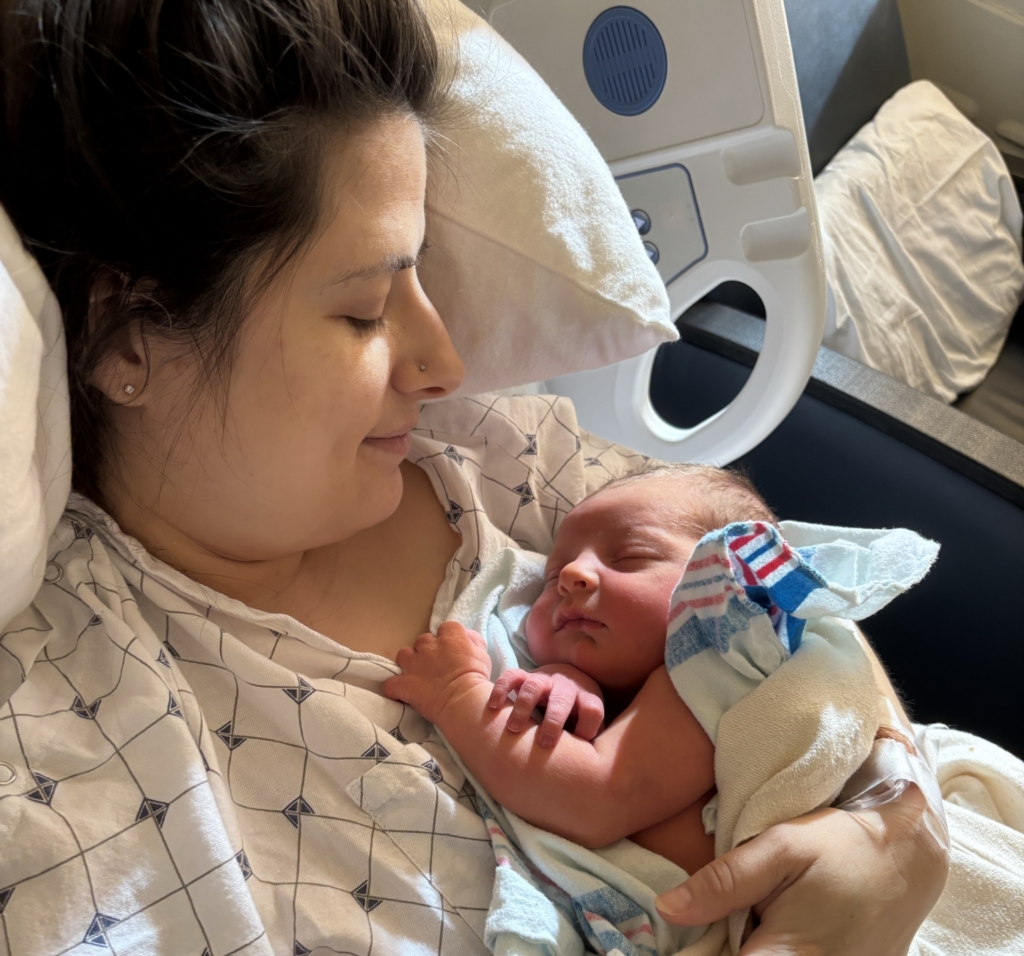
Mother wearing a hospital gown holding sleeping newborn baby in a hospital bed.

This spring I welcomed my second son, almost exactly five years after the birth of his big brother. He arrived in a different world. 

The “it” diaper bag, play gym, and baby carrier trends had all already changed, of course. But my oldest was also born one year into the pandemic, an isolating time to become a first-time parent. It was an entirely differnet postpartum experience to spend most of our time out of the house making friendships and finding a village. 

There were postpartum circles, newborn cohorts, baby lap time at the library and meetups for parents on leave that had been indefintely postponed or virtual when I first became a parent. And alongside the social and emotional support these groups offered, I was more experienced and confident. 

Among all the real-life relationships we were building with other new parents, there was also an impossible-to-ignore AI boom. And somewhat to my surprise, I started using it.

I'm not paying for that.

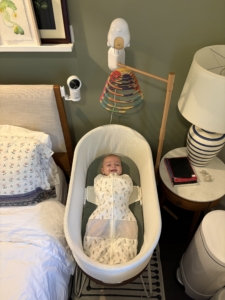
A smiling baby wrapped in a sleep sack inside of a Snoo-brand bassinet.

AI-enabled baby products or accompanying apps sit at the premium end of an already expensive market. The Snoo, a bassinet that responds to crying with motion and sound, can cost around $2,000 to own or about $150 a month to rent, plus subscription fees. The Nanit—an AI-powered monitor many of our friends use and that, which many of our friends use and NY Times reporter Sapna Maheshwari calls the Eye of Sauron straddling the line between “creepy and delightful”—starts at $290 for the system and premium versions of its app with full features start at $100/year.

Those prices put these products out of consideration for my budget-driven family. I also had privacy concerns. With our first child, I insisted on a video monitor that didn’t connect to Wi-Fi. Though in practice, I hated it because the portable screens constantly ran out of battery and broke easily.

My defenses of data privacy and frugality weakened once we became parents to two. Friends generously offered us their Snoo to borrow, and I jumped at the chance for better sleep and a handsome bassinet. We bought a Wi-Fi camera so we could use our phones instead of a flimsy display.

Then, shortly after returning from parental leave, ZERO TO THREE and Brookings partnered together for the Generation AI Starts Early event. My coworkers had ordered some AI-powered toys and products to learn more about them, and I volunteered to install a CuboAI monitor in our house to see what it was actually like to use.

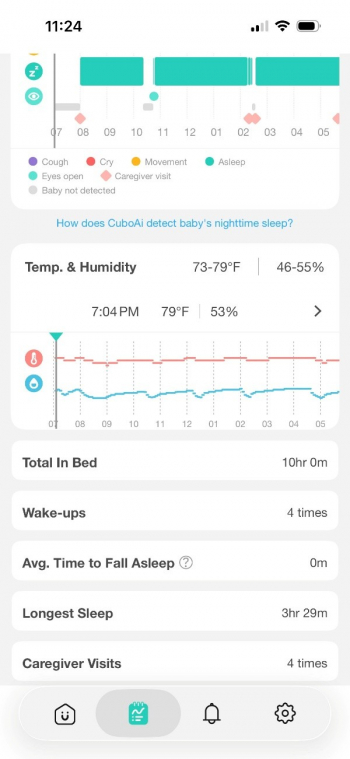
Almost immediately, it became useful for a feature I didn’t know I wanted: automatic sleep tracking. Despite the fancy bassinet, our baby isn’t a great sleeper. I can’t remember how many times he woke up last night, when, and for how long. The monitor does. Instead of asking me to remember to open an app and log every wake-up at 2:13 a.m., it creates a record automatically.

What does AI mean for babies and the adults raising them?

After our first son was born, my husband and I spent months manually recording naps, diapers, and feedings because he had feeding and weight-gain challenges.

When the pediatrician asked about wet diapers, we had an exact answer.

With our second, manual tracking lasted about a week. We didn’t have the same concerns and had five years of experience behind us. But we still track nighttime sleep so that when my husband takes over in the morning, he knows what kind of night we’ve had and when the baby was last awake and fed.

AI didn’t create parents’ desire for this information. We’ve been counting wet diapers, tracking feedings, and worrying about sleep for a long time. What AI changes is how the information is collected, what happens to that data, and how much work parents have to do themselves.

It also changes how much information is available to worry about. A parent who once knew “the baby slept badly” can now know that the baby woke seven times, averaged a particular length of sleep, slept differently than an app says babies of that age should. With almost no effort, caregivers can also track breathing, room temperature and humidity, roll overs, height, crying, coughing, and caregiver visits. Sometimes it creates more questions. Especially when the app or interface doesn’t provide any interpretation or guidance for understanding the data or when that guidance is incorrect.

AI could change which sources parents come across, who they trust and when they decide to ask another person for help.

AI didn't invent intensive parenting

I bristle when I hear some version of, “Back in my day, we didn’t have video monitors, and you all turned out fine.”

Obviously. But the comment can feel dismissive, as though one generation’s parenting practices are the reasonable baseline and anything parents use today needs to be defended. Technology changes. The tools available to parents change. More importantly, parenting has changed.

In the 2024 Parents Under Pressure advisory, the U.S. Surgeon General described parents dealing with pressure from all sides: balancing work and family, financial stress, high expectations, loneliness, and worries about children’s safety and technology use. Then companies show up with products promising to make some part of that enormous job easier. Of course parents are interested!

But you have to convince people there is a problem before you can sell them a solution. “Baby monitors have roots in fear,” as Ms. Maheshwari puts it. Families have been told for decades about all the ways children might be at risk and all the things responsible parents should monitor, prevent, encourage, track, or optimize.

Screenshot from the CuboAI app showing a minute-by-minute tracker of a baby's sleep and caregiver visits, a chart charting temperature (73-79 degrees) and humidity (44-55%), and reporting total time in bed (10 hours 0 minutes), wakeups (4 times), Average time to fall asleep (0 minutes), longest sleep (3 hours 29 minutes) and caregiver visits (4 times).

How do we make sure these tools help — not harm — early development?

AI is not going away, and the decisions made now will shape an entire generation. How will we prepare for it? ZERO TO THREE joined the Center for Universal Education at Brookings Institution to help answer this defining question

There are good reasons to be skeptical.

Companies selling AI-powered baby products didn’t create this culture of parental anxiety. But they are part of it, even as they promise their products will make parenting easier. And when the technology gets things wrong, it becomes a lot less useful.

A notification intended to provide reassurance can become one more thing to check. A dashboard can turn normal variation into something that looks like a problem. A night that felt fine can suddenly look concerning when translated into charts, percentages, alerts, and comparisons. And inaccuracies often undermine their usefulness. 

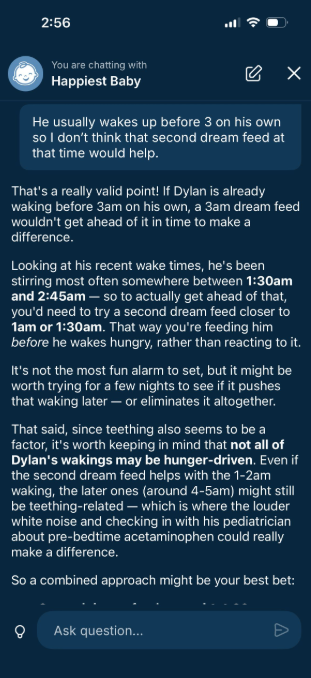
It took only a handful of prompts for one of my sleep apps to suggest feeding my 5-month-old every two hours at the beginning of the night, ridiculous advice that entirely disregarded his development stage and my need for sleep.

A screenshot of a chat. It begins "You are chatting with Happiest Baby." Message from app user: "He usually wakes up before 3 on his own so I don't think that second dream feed at that time would help." Response from the app: "That's a really valid point! If Dylan is already waking before 3am on his own, a 3am dream feed wouldn't get ahead of it in time to make a difference. Looking at his recent wake times, he's been stirring most often somewhere between 1:30am and 2:45am - so to actually get ahead of that, you'd need to try a second dream feed closer to 1am or 1:30am. That way you're feeding him before he wakes up hungry, rather than reacting to it. It's not the most fun alarm to set, but it might be worth trying for a few nights to see if it pushes that waking later - or eliminates it altogether. That said, since teething also seems to be a factor, it's worth keeping in mind that not all of Dylan's wakings may be hunger-driven. Even if the secvond dream feed helps with the 1-2am waking, teh later ones (around 4-5am) might still be teething-related - whis is where the louder white nouse and checking in with his pediatrician about pre-bedtime acetaminophen could really make a differernce. So a combined approach may be your best bet:-

The CuboAI’s temperature reading consistently ran higher than our thermostat. Its alerts were surprisingly accurate at detecting when our baby was placed in or removed from his crib or cried—until we used a pink swaddle. The camera apparently confused the swaddle with the baby and began sending constant notifications that he was being picked up and put down. Friends who use these products often give the same qualification: useful, but not always right.

And inaccurate data is only one problem. Perfectly accurate data can still be unhelpful. Knowing that your baby moved 14 times, woke for three minutes at 1:47 a.m., or slept 23 minutes less than yesterday does not necessarily come with an answer about what any of that means or what you should do as a parent.

In the The New York Times article, a pediatrician expressed concern that hyper-detailed tracking can undermine parents’ confidence in their own judgment. I understand that concern, but I don’t think it fully describes how many parents actually use these tools.

We need to explore those questions without making parents and their anxiety the problem.

And parents may be more skeptical than we think.

At the Generation AI Starts Early symposium, I demonstrated the Snoo and CuboAI and shared screenshots from parents in my baby groups. One question kept coming up: “But why would anyone want this?”

So here’s my experience.

I don’t think I need a smart monitor. Once I tried one, I found automatic tracking convenient. I don’t find most of its data particularly compelling. I ignore information that isn’t useful. I turn off notifications. When a number seems wrong, I don’t assume the computer knows better.

But I can also imagine another version of me where the exact same features would be miserable. Someone already anxious about sleep might not experience a detailed sleep dashboard as helpful information. They might experience it as a nightly scorecard. Someone worried about their baby’s safety might find constant alerts reassuring, or they might find that the alerts make them hypervigilant. 

From talking with friends, I don’t think I’m unusual. The media often talks about technology as though using it means relying on it. But parents can appreciate knowing their baby slept for 42 minutes without reorganizing their lives around that number. It’s not hard to find reviews of AI baby products referring to inaccurate data and reporting and parents posting that they turn off unhelpful notifications.

The other concern I heard was that parents will turn to AI and chat bots instead of their pediatricians and each other. For me and my friends, I don’t think it’s either/or.

I work in digital strategy at ZERO TO THREE, where part of my job is understanding why people visit our website. We get significant organic traffic from people I’ve always thought of as “midnight worriers,” parents awake late at night searching questions about tantrums, exploring bodies, stuttering, sleep, and all things that become urgent when you’re responsible for a small human. 

Parents have always looked for information. Search engines changed where they looked. Smartphones changed when they looked. Now AI is changing how they look.

But constant change doesn’t mean the change doesn’t matter. A chatbot that gives you an answer directly is different from a search engine that sends you to a pediatrician, child development organization, parenting group or community resource. AI could change which sources parents come across, who they trust and when they decide to ask another person for help.

Five years from now, this will look different again.

Five years separate my sons, and already their newborn periods have felt dramatically different.

I’m not convinced AI-powered consumer baby products are transforming parenting for the better. I’m also not convinced they’re destroying parents’ instincts. The more interesting questions are in between. Does automatic tracking reduce parents’ mental load or increase anxiety? When does information reassure us, and when does it give us something new to worry about? How do inaccuracies affect trust? Does getting an answer from a chatbot change whether someone calls a pediatrician? And what happens when today’s optional, expensive technology starts to feel like another requirement of responsible parenting?

We need to explore those questions without making parents and their anxiety the problem. Parents are making decisions in the world we’ve built around them: one with high expectations, expensive products, limited support, endless information and decades of messages about everything that could go wrong. AI entered that world very quickly. The parents bringing home a newborn five years from now may have a completely different relationship with AI, just as my experience with my second son is different from my experience with my first.

For now, there’s an AI-powered camera above my baby’s crib. I don’t think it’s making me a better parent. I don’t think it’s making me a worse one either. Mostly, it reminds me how badly I slept last night.

Advertisement
Advertisement
Next Up
distillation
AI and Early Childhood Development: Frequently Asked Questions
Experts address frequently asked questions about artificial intelligence (AI) and early childhood development.