AI and Early Childhood Development: Frequently Asked Questions

Key Takeaways
- Relationships matter most. Young children learn and thrive through responsive interactions with parents, caregivers, educators, and peers—not AI tools.
- Prioritize safety and privacy. Choose AI tools carefully, protect children’s data, and avoid products that encourage emotional dependence, tracking, or targeted advertising.
- Use AI to support adults, not replace them. The most effective uses of AI help caregivers and educators save time, access resources, and strengthen the human connections that drive healthy development.
Experts address frequently asked questions about artificial intelligence (AI) and early childhood development.
Guidance for Supporting Young Children in an AI-Driven World
Artificial intelligence (AI) is becoming increasingly present in the lives of young children, from smart toys and interactive apps to tools used by parents, educators, and caregivers.
While AI offers new opportunities to support learning and streamline caregiving tasks, it also raises important questions about privacy, healthy development, and the role of human relationships in early childhood. As families and professionals navigate this rapidly evolving technology, it is essential to understand both its potential benefits and its limitations—and to ensure that children’s well-being remains at the center of every decision.
Below, we’ll address some common questions about AI’s impact on young children.
How can adults support healthy development when introducing young children to AI tools, such as apps and smart toys?
For babies and toddlers, an engaged and attentive adult is more important than any piece of technology. AI tools should never replace all the amazing benefits of face-to-face interaction. Playing and reading together, talking with your little one, soothing and comforting, following their lead, and responding to their cues are exactly the kinds of interactions that young children need to thrive.
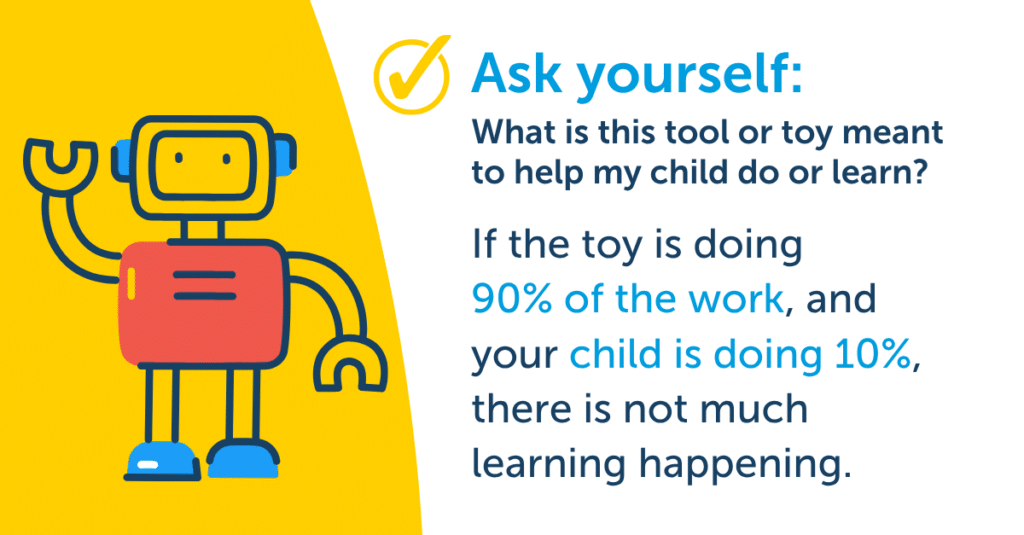
For children under three, there is not much learning benefit from AI apps or “smart” toys. To decide if these are a good fit for a child, families should ensure the app or platform features age-appropriate content and avoid any apps, toys or tools that use ads and tracking. Encourage parents to ask three questions as they evaluate AI tools:
- What is this tool or toy meant to help my child do or learn?
- What data is it sharing and with whom?
- Does it support my relationship with my child?”
What are the biggest digital safety concerns for young children today, and how can adults ensure technology supports healthy development?
The biggest priorities for digital safety are child privacy and digital designs that encourage children to build a relationship with AI tools and toys. Young children should not be tracked, profiled, or targeted for advertising. They should also not be encouraged to form strong emotional bonds or share feelings with AI toys or tools. AI tools and toys should be designed with a “safety from the start” approach. Industry standards and government policies should be established to ensure strong default protections for infants and toddlers are in place from the start (opt-out, rather than opt-in.)
What are the special considerations for children with disabilities and their families?
AI may be helpful for children with disabilities. Some tools have been shown to support communication and help build skills for older children. One of the strongest advantages may be in aiding caregiver and educator planning. But children with disabilities may also face higher risks if AI-enabled tools collect sensitive data or replace individualized human support and relationships.
How can AI mirror human interaction and affect attachment in young children?
AI is meant to sound friendly! It responds quickly, ‘remembers’ your likes and dislikes for later, and asks questions to keep the conversation going. AI is also designed to agree with you! Those features can make it feel like a fun social partner, especially to young children, who are still learning the difference between people and machines. If children rely more on AI-enabled toys for social interaction than on peers and adult caregivers, they miss out on important early social experiences. The more they are interacting with a machine, the less time they have for building skills like learning to see another person’s perspective, managing conflicts, and experiencing the pleasure of connecting and collaborating.
How might AI widen or reduce current disparities in child health and development?
If educators are trained on early digital literacy and parents are given resources to help their child succeed, AI could be a low-cost way to personalize and enhance early learning, or widen access to information on child development.
However, it could also widen existing disparities. AI systems are only as good as the data they are trained on, and when children from certain racial, cultural, socioeconomic or disability groups are underrepresented in that data, the tools may be less accurate or effective for them. In addition, children and families in lower-income, rural, or otherwise underserved communities may have less access to high-quality AI tools, reliable technology infrastructure, and educator training opportunities.
AI can also reflect patterns in the data it is trained on, which may reinforce existing gaps in education, health care and developmental supports. To help ensure AI benefits children and families, policymakers, educators, technology developers and communities should prioritize transparency, careful oversight and strong safeguards from the start.
Does research show introducing AI into young children's learning positively affect their academic success? Should we introduce AI to young children?
There is evidence that young children can begin learning what AI can and cannot do between 4- and 5–years olds. High quality, AI-enabled learning tools can also personalize learning for children and help them learn new skills, but they are not necessary for learning or academic success. The research is clear: infants, toddlers, and older children build the strongest foundation for learning through play, exploration, and “in real life” interactions with adults and peers. It’s okay to wait to introduce your child to AI. Developing digital literacy is important, but it can come later. In the early years, protect time for relationships, play, and exploring the world together. For more about AI and young children, see our resource on preschool children’s understanding of AI.
Tips to choose high quality screen experiences.
Are there examples of AI tools or approaches that have successfully supported caregivers and educators in early learning environments while still keeping the child-to-human relationship central?
AI might be most useful when it supports the adults caring for young children! AI can help with drafting activity ideas, suggesting supports or adaptations for children with special needs, or helping educators reflect on classroom challenges. AI-enabled tools can also help with administrative tasks and data tracking in the early education setting. These uses keep the teacher-child human relationship as the focus. AI should save adults’ time and support high quality interactions with children. It should not replace or take over the vital role teachers and caregivers play in children’s lives.
Are there examples of AI tools or approaches that have successfully supported caregivers and educators in early learning environments while still keeping the child-to-human relationship central?
AI might be most useful when it supports the adults caring for young children! AI can help with drafting activity ideas, suggesting supports or adaptations for children with special needs, or helping educators reflect on classroom challenges. AI-enabled tools can also help with administrative tasks and data tracking in the early education setting. These uses keep the teacher-child human relationship as the focus. AI should save adults’ time and support high quality interactions with children. It should not replace or take over the vital role teachers and caregivers play in children’s lives.
What skills should early childhood educators develop to use AI appropriately in the preschool classroom?
Teachers need to be able to make practical judgments about how AI can support children’s learning and deepen the human relationships in the classroom. Helpful skills include: (1) evaluating whether a tool is age-appropriate, (2) knowing how to assess if a tool is protecting child and family data, (3) spotting bias or inaccurate information, and (4) knowing how to explain what AI is and what AI can (and cannot) do simply to students.
Most importantly, educators should ask whether the tool strengthens learning and human relationships. You can use our E-AIMS Model and our resource on using technology intentionally to help you choose digital content and tools for young children.
AI in the Nursery
In partnership with the Center for Universal Education at Brookings, this panel explores the needs of babies and toddlers, the opportunities and potential risks as AI enters family life, and how parents, caregivers, educators, and policymakers can navigate an increasingly complex technological landscape.
Questions featured on this page were submitted as part of this virtual event.
Next Up
Go to Next Resource
resource
AI Slop or High-Quality Screen Content? How Parents Can Tell the DifferenceDiscover the clear indicators of AI-slop that we can use to make good decisions about what kids are watching.