
Clinical Practice
About
Pediatrics Supporting Parents (PSP) builds upon the powerful truth that early relationships matter. PSP’s five Proof Point Communities (PPCs) intentionally partner with families to innovate clinical practice within pediatrics and make both social-emotional development and nurturing relationships central to every visit. The well-child visit schedule offers frequent, broadly accessible, and non-stigmatized touchpoints with families during the critical birth-to-three years, a period when additional resources and supports are especially important. The relationships formed in a child’s earliest years can shape developmental pathways and influence how children adapt and grow, including in the face of adversity. With the combined expertise of families and providers, the broader Learning Community, and the funder collaborative, PSP advances practice change and invests in efforts that strengthen pediatric care.
View the video highlighting clinical practice to learn more.
The Journey
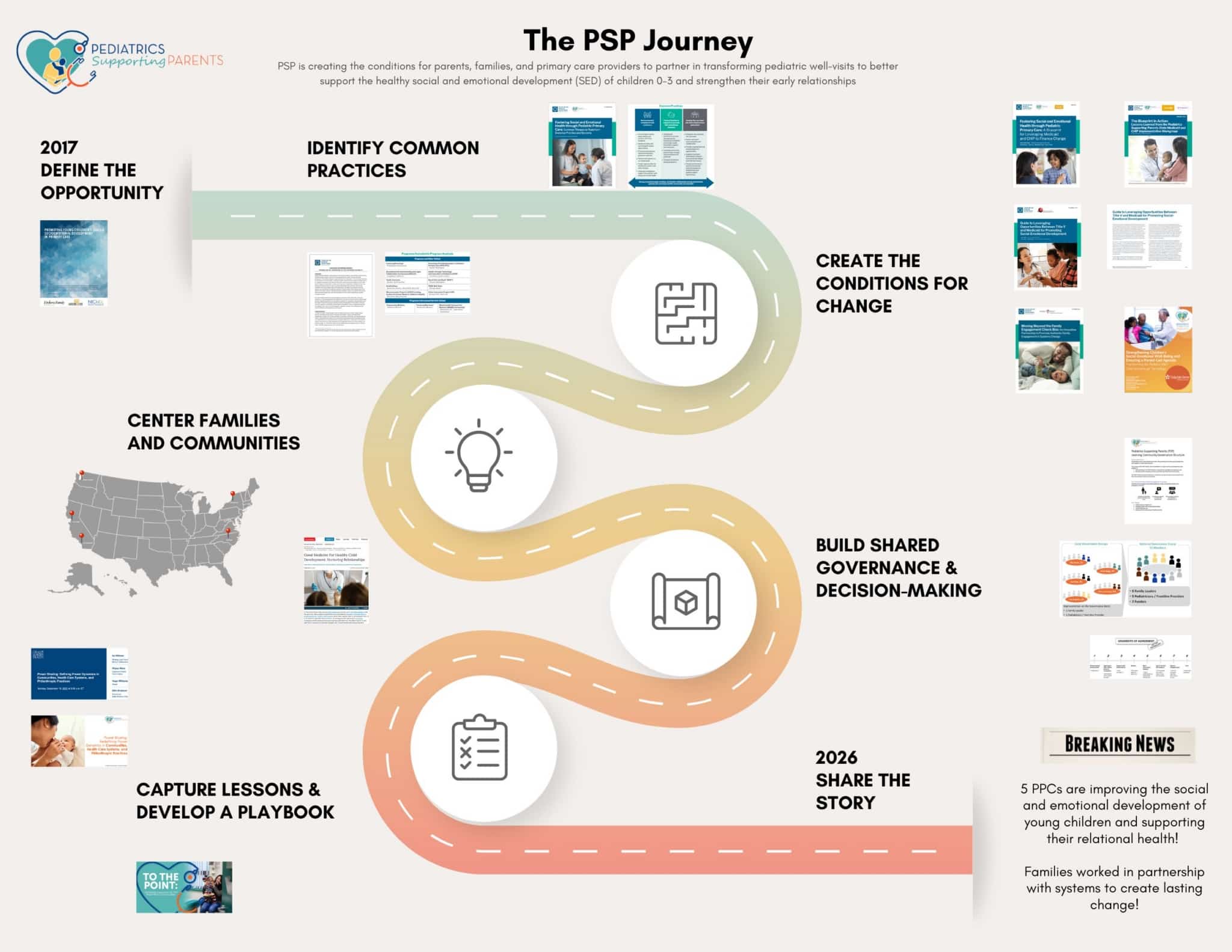
During Phase 1 of PSP, partners at the Center for the Study of Social Policy examined how pediatric primary care can promote young children’s social and emotional development and strengthen parent-child relationships. The team reviewed nearly 70 evidence-based and evidence-informed programs designed for pediatric settings and through detailed analysis and site visits with 13 selected programs, they identified 14 common practices shared across multiple models, helping clarify how pediatric care can systematically support families and advance key developmental outcomes.
Phase 2 of this work established a Learning Community and shared governance structure, with five proof point communities (PPCs) and funders forming a joint Governance Body to guide implementation, learning, and innovation development.
14 Common Practices
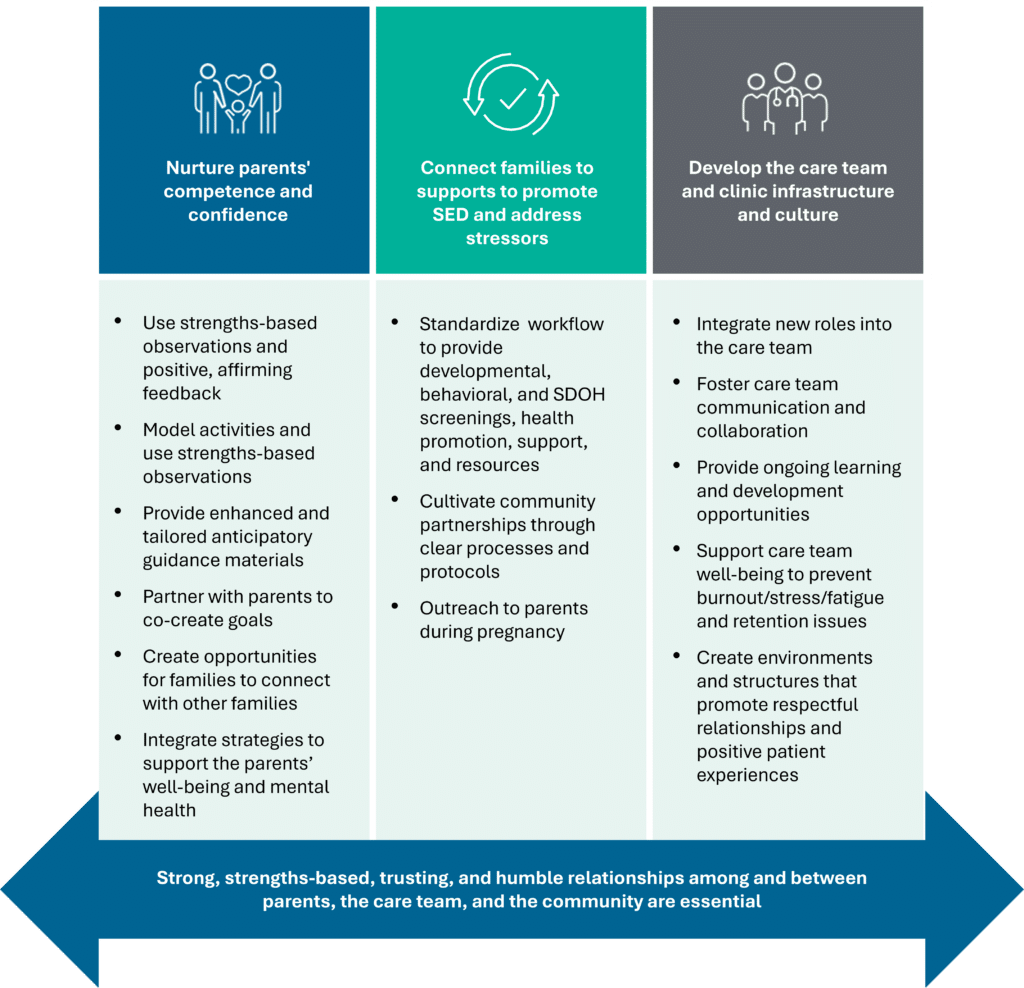
The 14 common practices identified through this work offer powerful guidance for helping healthcare teams support children’s healthy development and strengthen family bonds. Detailed in Fostering Social and Emotional Health through Pediatric Primary Care: Common Threads to Transform Everyday Practice and Systems, these practices reflect what families, providers, and communities have shown to be most effective in everyday care.
The practices fall into three key areas: empowering parents, connecting families to helpful resources, and building strong clinic teams and systems. At the heart of every successful approach are authentic, respectful relationships built on trust and mutual understanding. When pediatric providers, families, and communities come together with curiosity, humility, and care, they create environments where both children and parents can flourish.
Innovations
Building off the 14 common practices, the five PPCs identified, developed, and tested innovative approaches to transform the well-child visit across several topic areas. These teams co-created practical solutions to strengthen early relational health and support both the families and practitioners at the heart of this work. All of the innovations fell into one or more of the topics identified below.

Integrated Team-based Care

Care Team Well-being

Pediatric Resident Training

Family Engagement

Data Collection / Technology
Key Learnings and Impacts
Addressing family stress strengthens care delivery. Integrated team-based care and effective referral processes that identify and respond to families’ economic, social, and emotional needs improve family experience and outcomes while supporting pediatricians and clinicians.
Transforming care does not require longer visits. Integrating relational health into routine care can strengthen connections with families and enhance care for children, without adding time to appointments.
Relational care can be applied across diverse clinical and community settings. When tools, workflows, care models, and resident training are co-created with clinicians, administrators, families, and communities, relational health becomes embedded in health systems which creates the conditions for lasting culture change.
Resources
Fostering Social and Emotional Health through Pediatric Primary Care: A Blueprint for Leveraging Medicaid and CHIP to Finance Change (June 2019)
This blueprint explores how Medicaid and Children’s Health Insurance Program (CHIP)—which cover nearly half of children under three—can be leveraged to finance and sustain effective and proven pediatric well-child visit practices that make social and emotional health a routine, expected part of pediatric care.
Fostering Social and Emotional Health through Pediatric Primary Care: Common Threads to Transform Everyday Practice and Systems (October 2019)
Drawing on qualitative research from innovative primary care sites, this paper explores how pediatric well-child visits can be transformed into a powerful platform for nurturing children’s social and emotional development, strengthening parent-child relationships, and supporting parents’ mental health.
Guide to Leveraging Opportunities Between Title V and Medicaid for Promoting Social-Emotional Development (December 2020)
Drawing on existing state innovations and federal policy, this guide provides a framework for state Title V and Medicaid programs to work together to transform pediatric primary care and advance health equity for young children’s social and emotional development.
The Blueprint in Action: Lessons Learned from the Pediatrics Supporting Parents State Medicaid and CHIP Implementation Workgroup (January 2022)
This brief shares accomplishments and lessons learned from a collaborative, nine-state effort over eighteen months to advance sustainable Medicaid and CHIP financing strategies that make social and emotional health a routine part of pediatric primary care—promoting health equity for young children and their families.
This issue brief outlines the Pierce County PPC’s efforts to sustainably fund Community Health Workers (CHWs) within pediatric primary care to promote physical and behavioral health integration. Drawing on lessons from Pediatrics Northwest’s implementation experience, it highlights remaining barriers—including billing limitations—and offers actionable strategies to ensure the growth and sustainability of the CHW workforce to advance whole‑child, integrated care across diverse clinical and community settings.
HealthySteps, a program of ZERO TO THREE, is an evidence-based program that embeds child development specialists directly into pediatric primary care practices, ensuring all families with children ages 0–3 receive tiered, whole-child support for healthy social, emotional, and cognitive development—right where families already go for care.
Reach Out and Read leverages the well-child visit to put books in the hands of families, equipping clinicians with a built-in strategy to promote early literacy, strengthen caregiver-child relationships, and support the healthy development of young children from birth.
The Early Childhood Developmental Health Systems (ECDHS): Evidence to Impact Center, a ZERO TO THREE initiative, supports states and communities in building early childhood systems that secure the health and well-being of young children and their families by providing resources, tools, and implementation strategies for pediatric care transformation.
Bright Futures is a national health promotion and prevention initiative led by the American Academy of Pediatrics (AAP) that provides theory-based, evidence-driven guidelines and tools for all preventive care screenings and well-child visits, partnering with families, clinicians, and communities to promote optimal child health and well-being.
Nurture Connection is a national network that promotes Early Relational Health by building awareness, transforming systems, and partnering with families and communities to ensure every child benefits from the strong, positive, and nurturing early relationships that form the foundation for lifelong health and well-being.
Contact
To connect with the Pediatrics Supporting Parents team, email Kimberly Bradley at [email protected].